<?xml version="1.0" encoding="utf-8"?><feed xmlns="http://www.w3.org/2005/Atom" ><generator uri="https://jekyllrb.com/" version="4.4.1">Jekyll</generator><link href="https://www.varunchoraria.com/feed.xml" rel="self" type="application/atom+xml" /><link href="https://www.varunchoraria.com/" rel="alternate" type="text/html" /><updated>2026-07-18T23:20:26+05:30</updated><id>https://www.varunchoraria.com/feed.xml</id><title type="html">Varun Choraria</title><subtitle>Essays on AI, go-to-market strategy, management, careers, and building useful things from B2B marketing operator Varun Choraria.</subtitle><author><name>Varun Choraria</name><uri>https://www.varunchoraria.com/about/</uri></author><entry><title type="html">How to design without AI Slop</title><link href="https://www.varunchoraria.com/how-to-design-without-ai-slop/" rel="alternate" type="text/html" title="How to design without AI Slop" /><published>2026-07-08T00:00:00+05:30</published><updated>2026-07-08T00:00:00+05:30</updated><id>https://www.varunchoraria.com/how-to-design-without-ai-slop</id><content type="html" xml:base="https://www.varunchoraria.com/how-to-design-without-ai-slop/"><![CDATA[<h2 id="you-are-what-you-admire">You are what you admire</h2>

<p>If you’re tired of AI spitting out the same generic slop every time you ask it to design a landing page, the fix is simpler than it looks. It starts with taste.</p>

<p>As a marketer, good taste is close to a mandate. Marketing is a horizontal function: you’re stitching design, copy, and math into a single campaign, and it all has to feel like one thing.</p>

<p>Almost ten years ago I kept a swipe file. Vintage ads, headlines I loved, layouts I’d happily steal from. I’d flip through it before starting anything new. That swipe file was the prehistoric ancestor of the <code class="language-plaintext highlighter-rouge">taste.md</code> file doing the rounds on X right now.</p>

<p>A <code class="language-plaintext highlighter-rouge">taste.md</code> distills what good looks like: font pairings, color, WCAG contrast, spacing, the small decisions that separate <em>considered</em> from <em>generic</em>. You can write your own if you’re a designer, or, like me, reverse-engineer designs you admire and build on top of them.</p>

<p>That’s the whole trick. You are what you admire, and so is an LLM. Feed it slop references and it hands you slop. Feed it taste and it finally has something better to imitate.</p>

<h2 id="walking-the-talk">Walking the talk</h2>

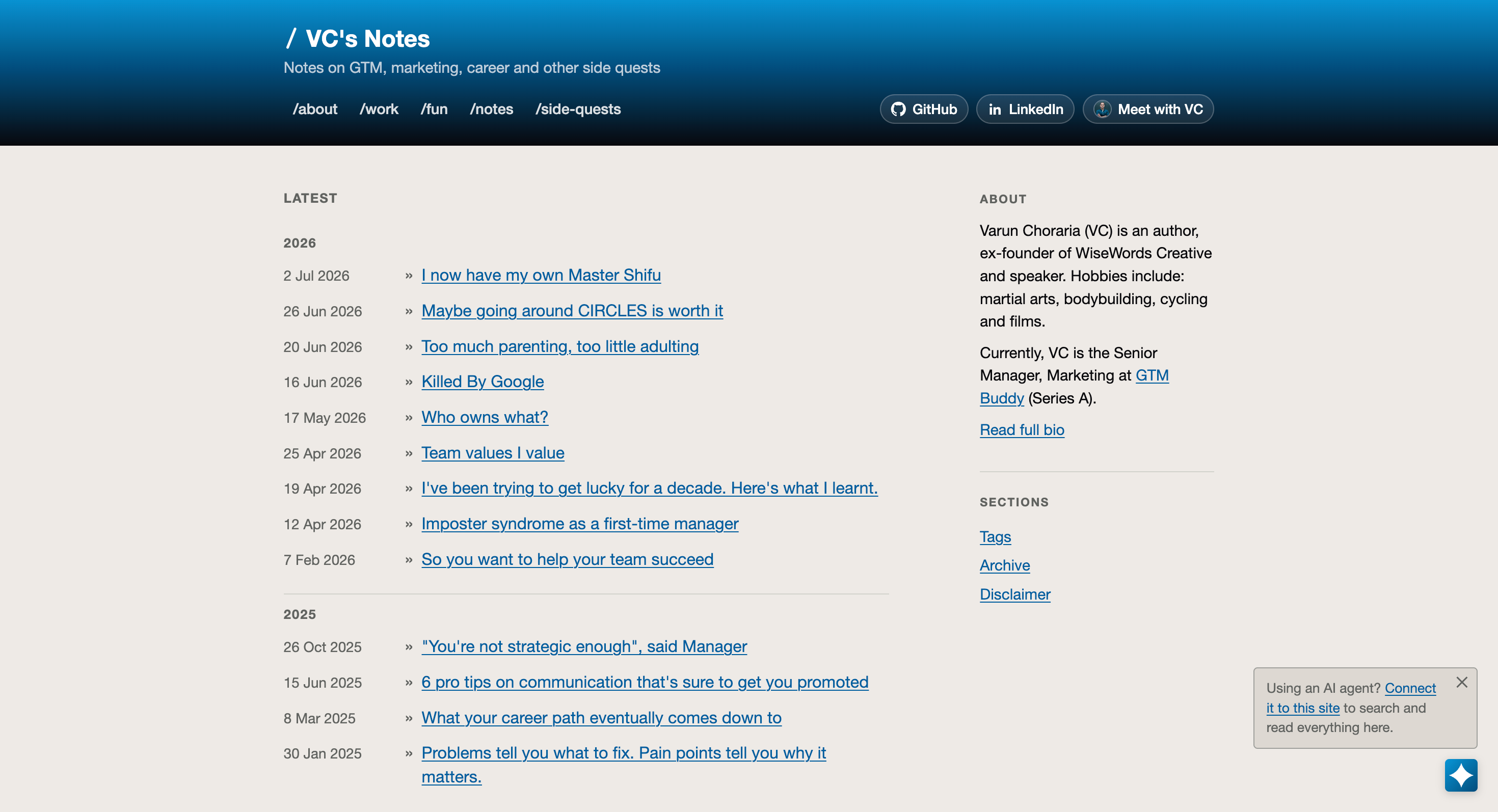
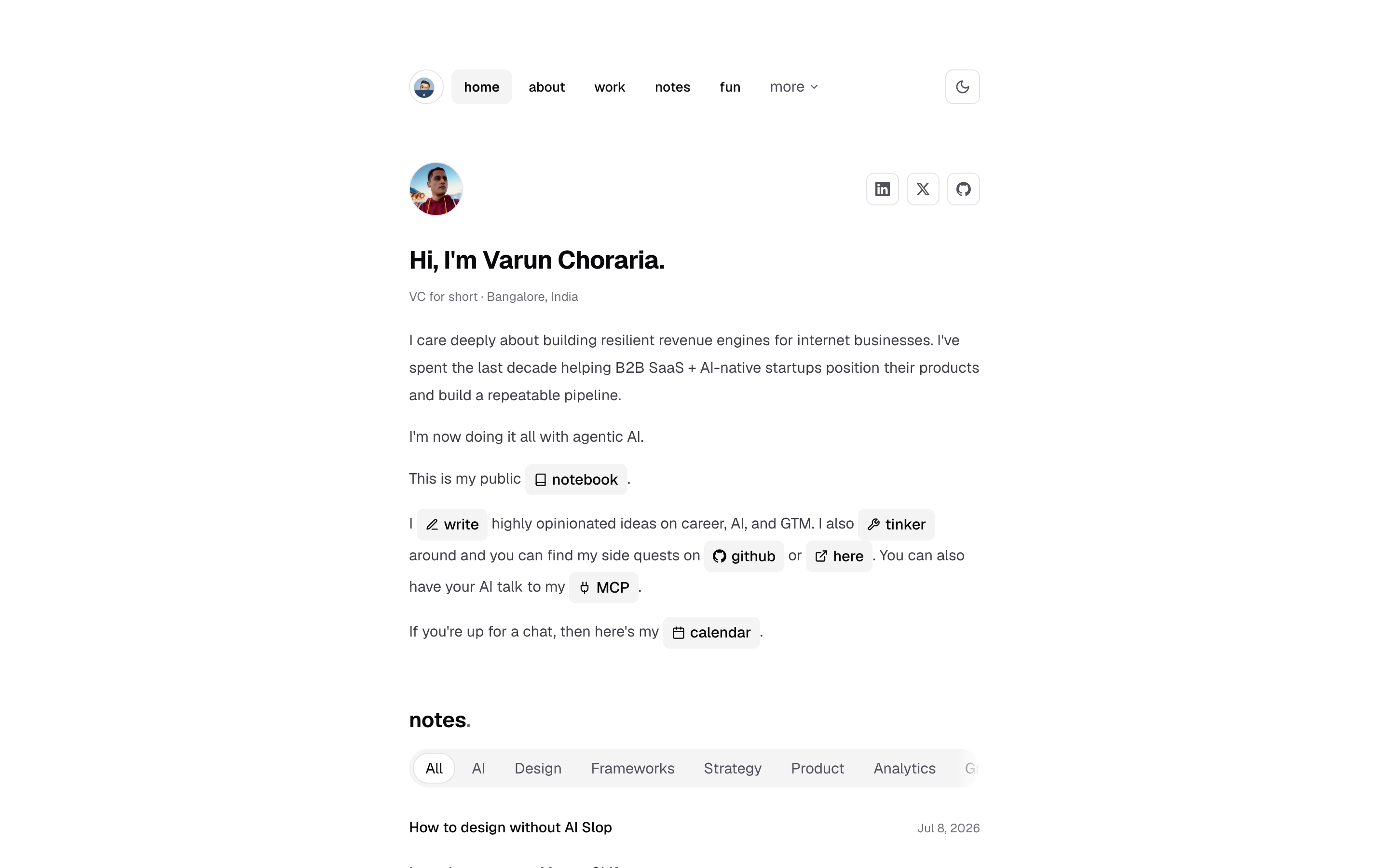
<p>I redesigned this site this week (<a href="https://www.varunchoraria.com/changelog/">here’s the changelog</a>). The old version was a busy, sidebar-heavy blog with a blue gradient and a nudge toast. I wanted something quieter and more modern. Before, and after:</p>

<p><img src="/assets/images/posts/slop-before-old-site.png" alt="The old varunchoraria.com: a blue gradient header, three-ish column layout with a right sidebar, and an MCP nudge toast" width="2940" height="1594" loading="lazy" /></p>

<p><img src="/assets/images/posts/slop-after-monochrome.png" alt="The redesigned varunchoraria.com: a single centered column, strict monochrome zinc palette, and quiet typography-first chrome" width="2880" height="1800" loading="lazy" /></p>

<p>Here’s the exact process, and one you can copy.</p>

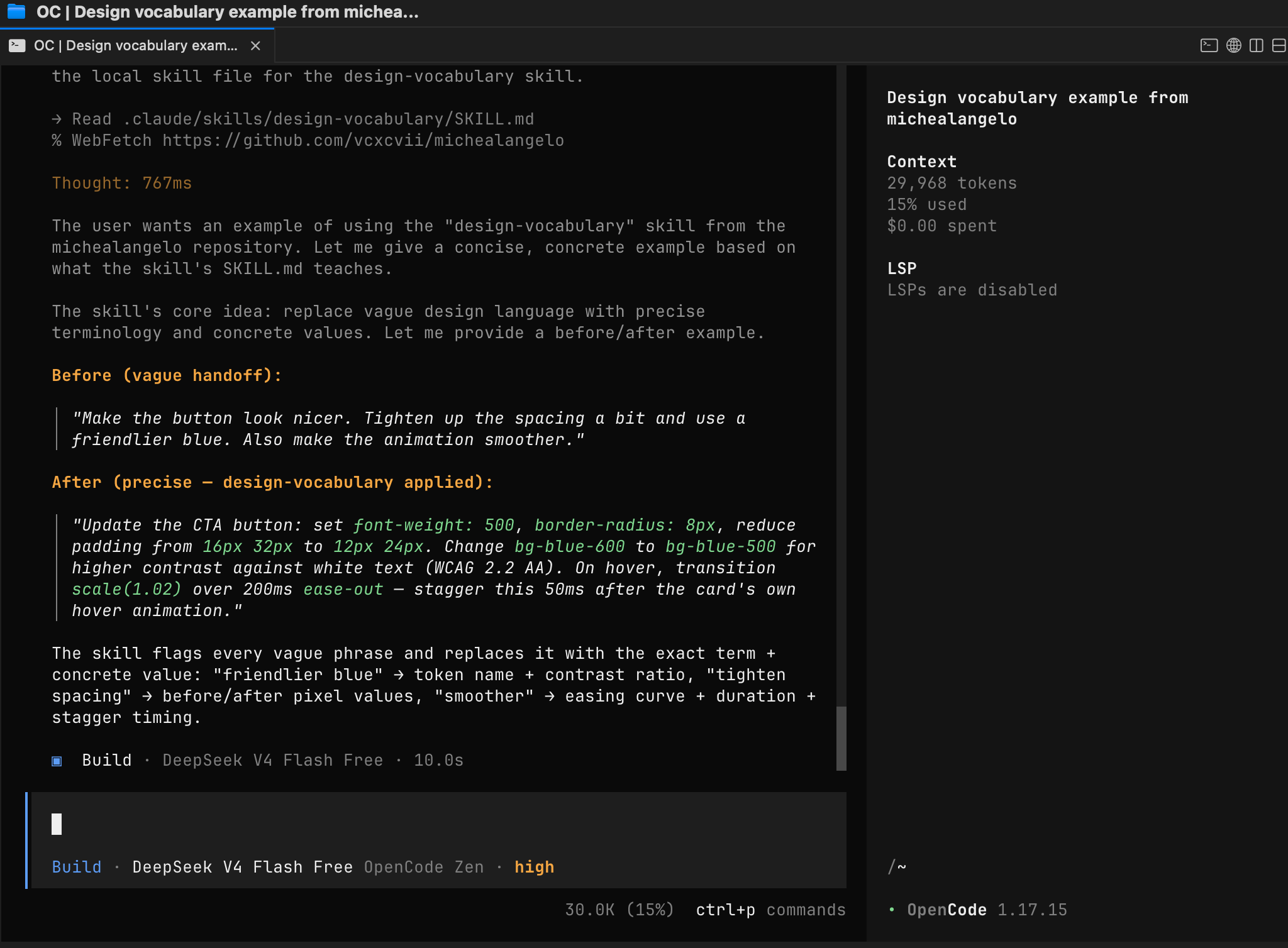
<p><strong>Spin up Claude and switch to the best model.</strong> If you can’t stretch to Claude Pro, or you’d rather run something like <a href="https://opencode.ai/">opencode</a>, point it at my repo, <a href="https://github.com/vcxcvii/michealangelo">michealangelo</a>. It’s a skill pack you install <em>alongside</em> your agent, not a replacement for it. It encodes UI/UX principles, web guidelines, and design psychology into guardrails, plus a design and animation vocabulary so you can give precise feedback (“the easing feels mechanical”) instead of vague feedback (“make it nicer”).</p>

<p><img src="/assets/images/posts/slop-design-vocabulary.png" alt="An opencode session using the design-vocabulary skill: it rewrites a vague 'make the button look nicer, friendlier blue, smoother animation' request into precise values like font-weight 500, border-radius 8px, bg-blue-500 for WCAG contrast, and a 200ms ease-out transition" width="2048" height="1508" loading="lazy" /></p>

<p><strong>Treat it like a senior designer, not a pair of hands.</strong> A senior designer doesn’t push pixels all day. They exercise taste and judgement and direct the execution. Talk to the model that way.</p>

<p><strong>Feed it what you admire.</strong> Drop in screenshots of sites you love, palettes, fonts. Ask it to build on top, then add your own flavor. I wanted <a href="https://ui.shadcn.com/">shadcn components</a> for consistency and hierarchy. They’re free and genuinely handy.</p>

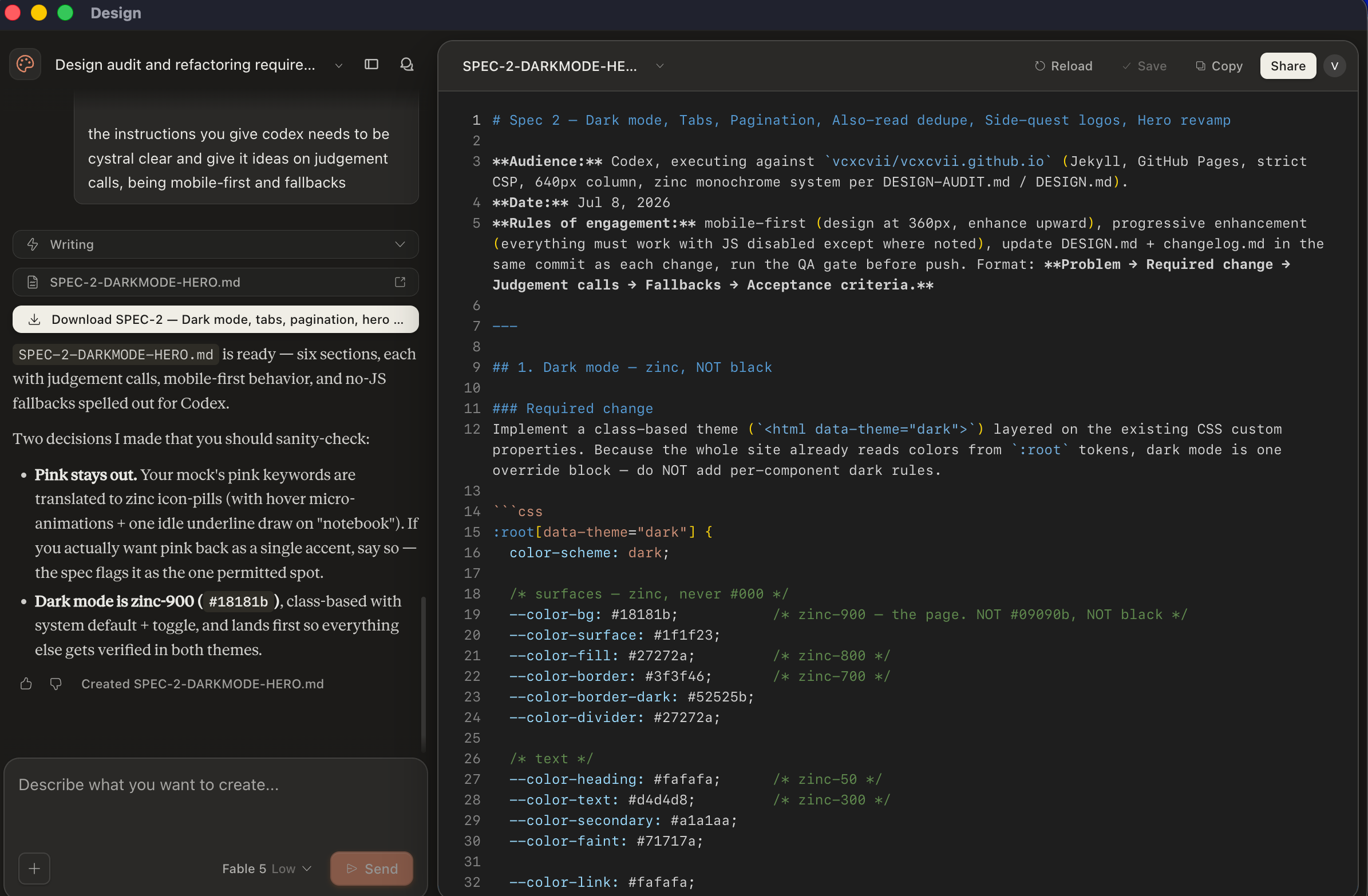
<p><strong>Get a written brief before anyone touches code.</strong> Ask Claude to generate a detailed design brief for whichever model will execute (I targeted Codex, then Claude Code). Annotating a live preview burns tokens fast. A brief is cheaper, and it travels between tools.</p>

<p><img src="/assets/images/posts/slop-design-brief.png" alt="Claude generating a machine-readable spec for Codex: a mobile-first dark-mode and hero brief with problem, required change, judgement calls, fallbacks, and acceptance criteria" width="2390" height="1566" loading="lazy" /></p>

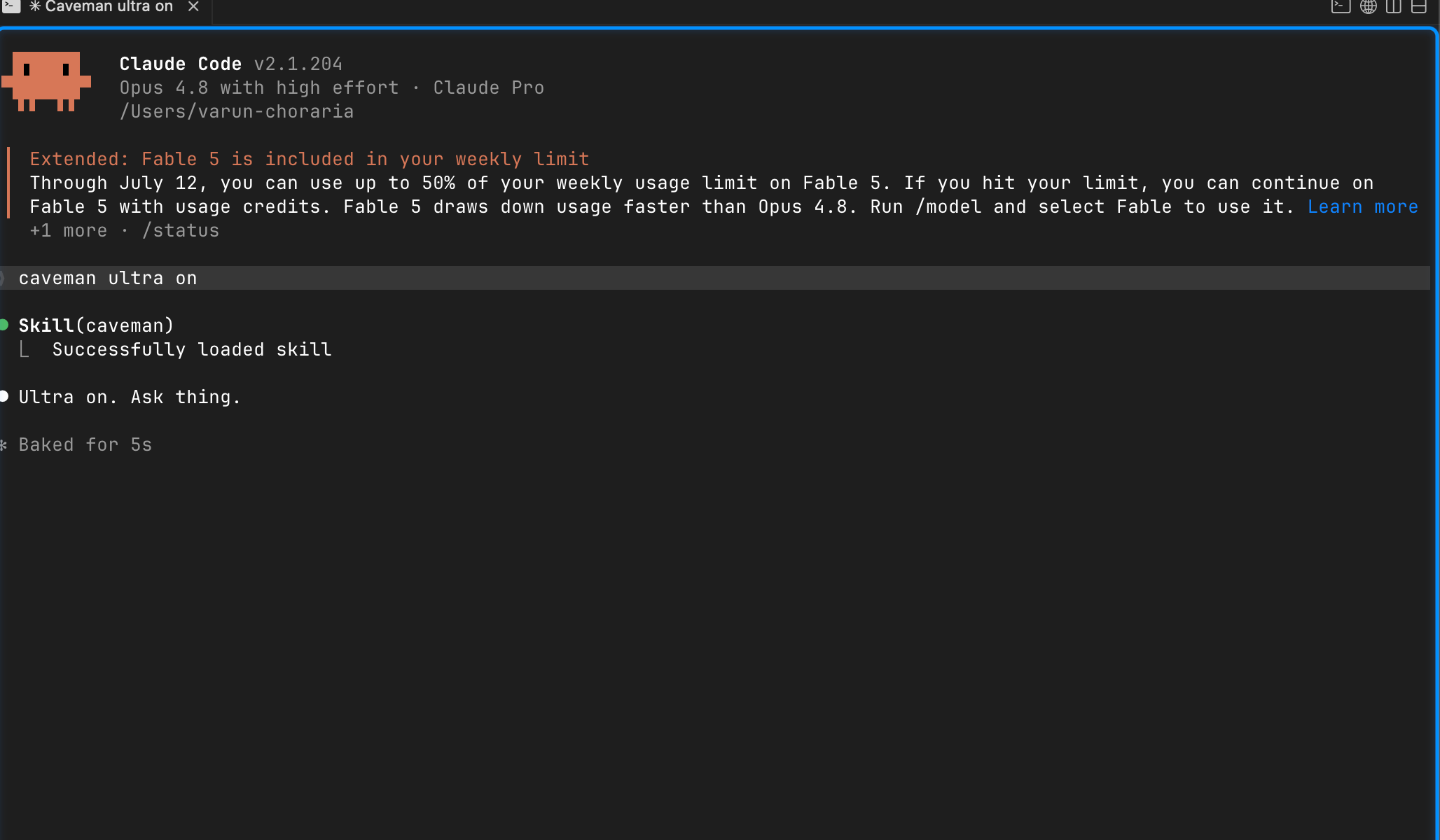
<p><strong>Execute in the CLI.</strong> I use Claude Code partly because <a href="https://github.com/JuliusBrussee/caveman">caveman ultra</a> cuts token spend by roughly 65% (measured) per session. Pick a mid-tier model on medium effort to execute, and save the frontier model for the thinking. Ship it for free on GitHub Pages, or on Vercel.</p>

<p><img src="/assets/images/posts/slop-caveman-cli.png" alt="Claude Code in the terminal on Opus 4.8, loading the caveman skill in ultra mode to compress its own output and save tokens" width="2056" height="1200" loading="lazy" /></p>

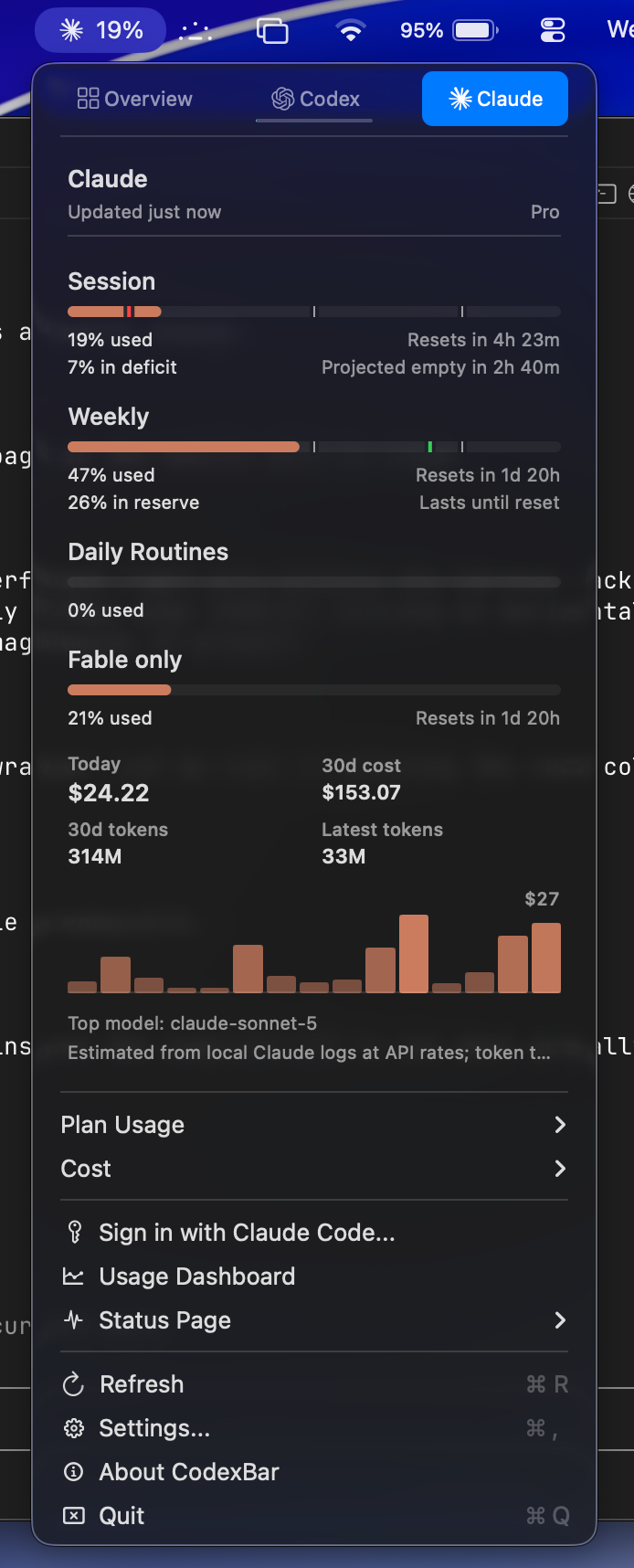
<p><strong>Watch your spend.</strong> Something like <a href="https://github.com/steipete/CodexBar">CodexBar</a> keeps token usage visible. This whole update, adding an “ask any AI about me” band and restoring my RSS feed to the nav, cost about 19% of a single session.</p>

<p><img src="/assets/images/posts/slop-codexbar.png" alt="CodexBar menu-bar app showing session usage at 19% for the current update" width="694" height="1716" loading="lazy" /></p>

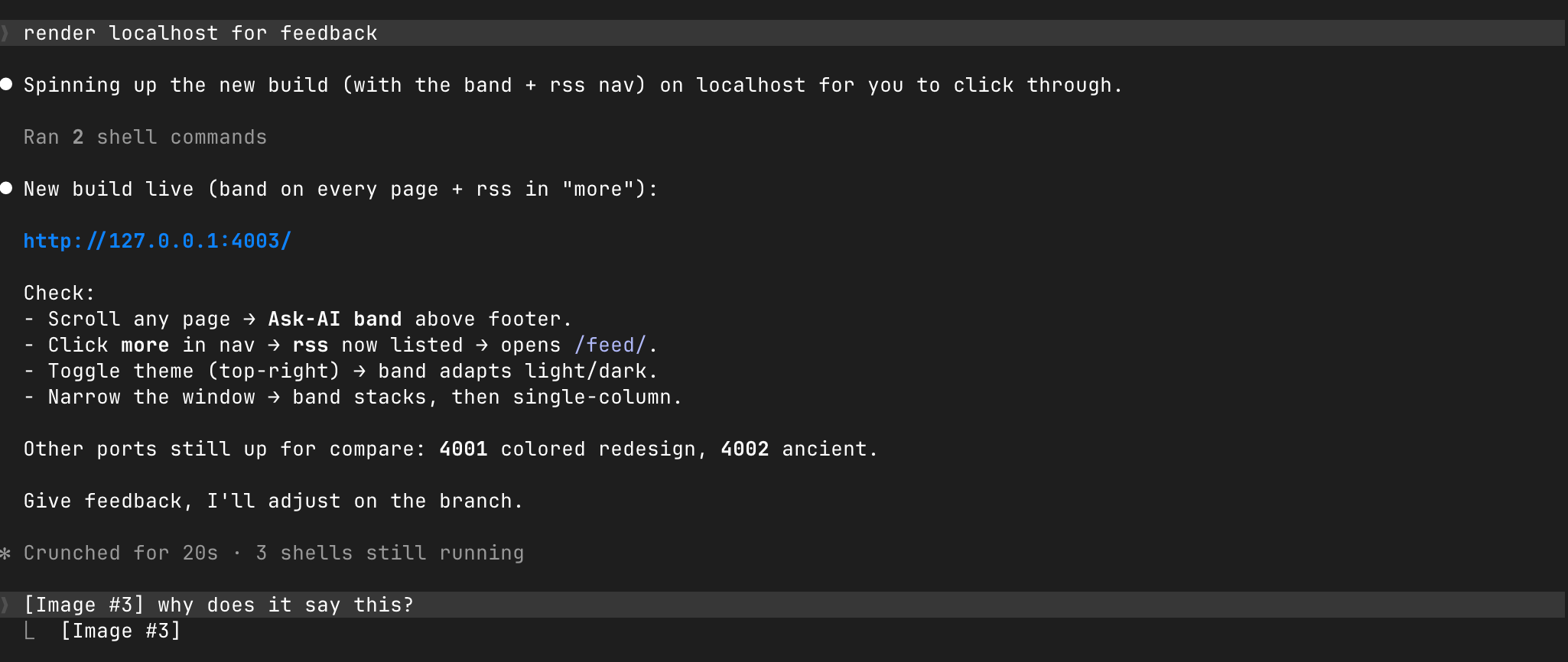
<p><strong>For feedback, render locally.</strong> Ask the agent to serve it on localhost. Want to compare versions? Spin up a few ports at once (I ran 4001, 4002, and 4003 side by side: ancient, colored, and the new monochrome build). Giving feedback is easy: just paste screenshots back.</p>

<p><img src="/assets/images/posts/slop-localhost-feedback.png" alt="Claude Code serving the rebuilt site on localhost so I can click through and paste screenshots back as feedback" width="2050" height="866" loading="lazy" /></p>

<h2 id="the-part-everyone-skips-enforce-it">The part everyone skips: enforce it</h2>

<p>Here’s what actually kills slop, and what most “just use a taste.md” advice leaves out.</p>

<p>A taste.md is a suggestion. Suggestions rot. Three sessions in, an agent quietly reintroduces a stray accent color or swaps your font on a button, and you don’t notice until it’s live.</p>

<p>So I didn’t just <em>document</em> taste. I made it a rule the machine checks.</p>

<p>My site is now strictly monochrome: one zinc scale, and the only color left is in photographs. That decision lives in a machine-readable <code class="language-plaintext highlighter-rouge">DESIGN.md</code>. And a pre-push QA gate fails any commit that reintroduces a hue, a legacy class, or the wrong font on UI. If an agent, or me at 1am, tries to sneak color back in, the push is blocked before it ships.</p>

<p>That’s the shift: taste as a <em>test</em>, not a mood board. The mood board tells the model what good looks like. The test guarantees the codebase stays that way, no matter how many agents touch it after you.</p>

<p>Slop isn’t only a generation problem. It’s an entropy problem. Guardrails set the direction; enforcement holds the line.</p>

<h2 id="so">So</h2>

<p>You are what you admire, so curate what you admire, then encode it. Write the swipe file. Turn it into guardrails. Make the guardrails enforceable. Do that and the generic look doesn’t just leave, it can’t come back.</p>]]></content><author><name>Varun Choraria</name><uri>https://www.varunchoraria.com/about/</uri></author><category term="ai" /><category term="design" /><summary type="html"><![CDATA[Killing generic AI-slop design isn't a prompt problem. Curate taste like a swipe file, then encode it as guardrails a pre-push gate actually enforces.]]></summary></entry><entry><title type="html">I now have my own Master Shifu</title><link href="https://www.varunchoraria.com/i-now-have-my-own-master-shifu/" rel="alternate" type="text/html" title="I now have my own Master Shifu" /><published>2026-07-02T00:00:00+05:30</published><updated>2026-07-02T00:00:00+05:30</updated><id>https://www.varunchoraria.com/i-now-have-my-own-master-shifu</id><content type="html" xml:base="https://www.varunchoraria.com/i-now-have-my-own-master-shifu/"><![CDATA[<p>I’ve been collecting consulting casebooks for about a decade. Kellogg, Wharton, Ross, Darden, IIM (A, B, C, I, L), MDI, Drucker, McKinsey, Victor Cheng, Crack the Case — 19 books in total, some of them 300+ pages.</p>

<p>They teach you how to think about business problems. Profitability, market entry, pricing, M&amp;A, operations — each framework is a lens. A structured way to decompose something messy into something solvable.</p>

<p>For years they sat in my iCloud collecting dust. I’d pull one out before a big work presentation or to prep for a strategy conversation, but the friction of <em>finding the right framework, remembering the steps, applying it correctly under pressure</em> meant I mostly just winged it.</p>

<p>Like most people do.</p>

<p>Last month, I fed every single book to Claude and turned each framework into a <code class="language-plaintext highlighter-rouge">/command</code>. Named the whole thing <strong>Master Shifu</strong> — because every AI agent needs a cranky old panda who forces it to think before it acts.</p>

<hr />

<h2 id="why-frameworks-fail-in-practice">Why frameworks fail in practice</h2>

<p>Here’s the thing about frameworks: they’re not the problem. The problem is how we use them.</p>

<p>Walk into any meeting where someone says “let’s run a SWOT analysis” and watch what happens. People brainstorm strengths for five minutes, skip weaknesses because it feels negative, make up a couple threats, and call it a day. The framework was present. The rigor was absent.</p>

<p>I’ve done this. You’ve done this. We’ve all done this.</p>

<p>A framework is only as good as the discipline with which it’s applied. And discipline is scarce. Especially when you’re in a room with six other people, the clock is ticking, and the CEO is looking at you expectantly.</p>

<p>That’s where the idea started. Not “let’s build an AI that knows frameworks” — there’s a million of those. But <em>“let’s build an AI that doesn’t skip steps.”</em></p>

<hr />

<h2 id="the-five-phases">The five phases</h2>

<p>The flow is simple but the difference is in the order.</p>

<p>When you tell Master Shifu a problem — say, “my SaaS margins are shrinking and I’m thinking about entering Brazil” — it doesn’t jump to conclusions. It runs five phases:</p>

<p><strong>1. Grilling.</strong> Round after round of clarifying questions. “What data do you have? How do you define margin? Is revenue growing or flat? What’s your current unit economics? Do you have any competitors in Brazil already?” It’s annoying on purpose. Most problems fall apart in the first five minutes if you ask the right questions.</p>

<p><strong>2. Five lenses.</strong> Before picking a framework, it looks at the problem from five angles: customer, competition, financial, operational, and market. Each lens can auto-populate with real data via web scraping. The competition lens will check if your competitor changed pricing last week. The financial lens can pull SEC filings. The market lens scrapes industry news.</p>

<p><strong>3. Framework match.</strong> Based on the enriched context, it selects 1-3 frameworks. Not a random guess — pattern-matched against the problem language and the lens outputs. It might return profitability + industry analysis + pricing. Or market entry + Porter’s Five Forces + break-even. Depends on what the problem actually needs.</p>

<p><strong>4. Apply.</strong> Each framework runs end-to-end. Step by step. It doesn’t skip the unattractive quadrant of Porter’s Five Forces. It doesn’t forget to calculate contribution margin in a break-even analysis. It applies the same rigor every time.</p>

<p><strong>5. Synthesize.</strong> The outputs from multiple frameworks are merged into a coherent recommendation. If profitability analysis pinpoints the problem as volume decline in Europe, and industry analysis flags a new entrant with lower pricing, the synthesis connects those dots explicitly.</p>

<p>I’ve caught myself reading the output and thinking <em>“huh, I wouldn’t have made that connection.”</em> That’s the whole point. I’m not outsourcing my thinking — I’m using the AI to catch the gaps in it.</p>

<hr />

<h2 id="32-frameworks">32 frameworks</h2>

<p>Currently there are 32. The heavy hitters:</p>

<ul>
  <li><code class="language-plaintext highlighter-rouge">/profitability</code> — P = R - C, segmented by product/channel/region</li>
  <li><code class="language-plaintext highlighter-rouge">/market-entry</code> — attractiveness → feasibility → competitive response</li>
  <li><code class="language-plaintext highlighter-rouge">/pricing</code> — cost-based, competitor-based, value-based with elasticity</li>
  <li><code class="language-plaintext highlighter-rouge">/industry-analysis</code> — Porter’s Five Forces, soup to nuts</li>
  <li><code class="language-plaintext highlighter-rouge">/m-and-a-fit</code> — synergies, one-way exploitation, integration risk</li>
  <li><code class="language-plaintext highlighter-rouge">/issue-tree</code> — MECE decomposition, hypothesis driven</li>
  <li><code class="language-plaintext highlighter-rouge">/growth-strategy</code> — Ansoff Matrix, the whole grid</li>
  <li><code class="language-plaintext highlighter-rouge">/bcg-matrix</code> — stars, cash cows, question marks, dogs</li>
</ul>

<p>Plus the less glamorous ones that matter more than people admit: due diligence, non-profit strategy, capacity expansion, outsourcing decisions, supply-demand analysis.</p>

<p>Because the real world isn’t a case interview. Sometimes you need to figure out whether to build a second factory in Vietnam. That’s a capacity expansion problem, not a profitability problem, and the tool should know the difference.</p>

<hr />

<h2 id="the-meta-skill-twist">The meta-skill twist</h2>

<p>There’s a skill called <code class="language-plaintext highlighter-rouge">task-observer</code> that watches every session and logs what the agent got wrong.</p>

<p>At the end of a heavy session, I just ask <em>“Any observations?”</em> and it surfaces things like:</p>

<blockquote>
  <p>“You ran the profitability framework but didn’t segment by channel. The issue tree would have caught this. Update the profitability skill to cross-reference issue tree for root cause isolation?”</p>
</blockquote>

<p>Or:</p>

<blockquote>
  <p>“The market entry analysis used outdated competitor data. Schedule the competition monitor to refresh weekly.”</p>
</blockquote>

<p>Meta, I know. But it’s the closest thing I’ve built to a self-improving system. Every session makes the next one better.</p>

<hr />

<h2 id="the-deeper-point">The deeper point</h2>

<p>I’ve been thinking a lot about what happens when your AI is no longer a question-answer machine but an actual extension of how you reason about problems.</p>

<p>The ceiling isn’t on the framework side — anyone can google “Porter’s Five Forces” and get a template. The ceiling is on the application side. Running it without bias, without skipping the hard parts, without rushing to confirm what you already believe.</p>

<p>That’s what Master Shifu does for me. Not because the AI is smart — because the structure is enforced. The scaffolding holds.</p>

<hr />

<p>It’s open source, MIT licensed. Because structured thinking shouldn’t be paywalled.</p>

<div class="language-bash highlighter-rouge"><div class="highlight"><pre class="highlight"><code>curl <span class="nt">-fsSL</span> https://raw.githubusercontent.com/vcxcvii/master-shifu/main/install.sh | bash
</code></pre></div></div>

<p>Or on my GitHub: <a href="https://github.com/vcxcvii/master-shifu">github.com/vcxcvii/master-shifu</a></p>

<p>If you’re a consultant, founder, PM, or just someone who wants their AI to think in frameworks instead of vibes — it’s yours. Steal it, fork it, break it, improve it. That’s what open source is for.</p>]]></content><author><name>Varun Choraria</name><uri>https://www.varunchoraria.com/about/</uri></author><category term="ai" /><category term="frameworks" /><category term="strategy" /><summary type="html"><![CDATA[I turned 32 consulting frameworks from 19 MBA casebooks into AI commands and named the whole thing after Master Shifu. Every agent needs a teacher.]]></summary></entry><entry><title type="html">Maybe going around CIRCLES is worth it</title><link href="https://www.varunchoraria.com/maybe-going-around-circles-is-worth-it/" rel="alternate" type="text/html" title="Maybe going around CIRCLES is worth it" /><published>2026-06-26T00:00:00+05:30</published><updated>2026-06-26T00:00:00+05:30</updated><id>https://www.varunchoraria.com/maybe-going-around-circles-is-worth-it</id><content type="html" xml:base="https://www.varunchoraria.com/maybe-going-around-circles-is-worth-it/"><![CDATA[<p>Frameworks get a bad rep. But early in your problem-solving journey, they’re scaffolding — not a crutch. Over time, as you get acquainted with more real-life scenarios, your intuition gets powerful enough to spot-check and work bottoms-up.</p>

<p>For the purpose of this field note, let’s stick to some 101s.</p>

<p>CIRCLES is a helpful framework to bring a rounded thinking hat to the table and actually ask good, focused questions. I first read this in <a href="https://www.crackingthepminterview.com/">cracking the PM interview</a>.</p>

<table class="fixed-cols">
  <thead>
    <tr>
      <th> </th>
      <th>Step</th>
      <th>Description</th>
    </tr>
  </thead>
  <tbody>
    <tr>
      <td><strong>C</strong></td>
      <td>comprehend the situation</td>
      <td>clarify what’s within scope and out of scope for the problem statement. eg: business goal, constraints</td>
    </tr>
    <tr>
      <td><strong>I</strong></td>
      <td>identify the customer</td>
      <td>figure out how to segment the customers. low hanging fruit will always be the biggest customer segment with the largest gap. list down firmographics, demographics, technographics - get your fact sheet in place about the customer’s day in the life.</td>
    </tr>
    <tr>
      <td><strong>R</strong></td>
      <td>report the customer’s needs</td>
      <td>list all their needs (not wants) in the order of priority. <a href="https://www.varunchoraria.com/problems-tell-you-what-to-fix-pain-points-tell-you-why-it-matters/">I wrote a helpful mental model here</a>.</td>
    </tr>
    <tr>
      <td><strong>C</strong></td>
      <td>cut through prioritization</td>
      <td>narrow the problem surface. from the prioritized needs, pick the highest-impact, most-urgent ones to address — don’t try to solve everything at once.</td>
    </tr>
    <tr>
      <td><strong>L</strong></td>
      <td>list down solutions</td>
      <td>generate 3-5 solutions per prioritized need</td>
    </tr>
    <tr>
      <td><strong>E</strong></td>
      <td>evaluate tradeoffs</td>
      <td>this needs to happen across 3 axes - implementation complexity, user impact, cost / benefit</td>
    </tr>
    <tr>
      <td><strong>S</strong></td>
      <td>summarize</td>
      <td>this is where you need to COMMIT. it’s fair to be opinionated here, because you need to pick a solution and defend it. In the age of agentic AI, we’re all compensated for context and judgement.</td>
    </tr>
  </tbody>
</table>

<!--more-->

<hr />
<h2 id="the-same-thing-works-in-rcas">The same thing works in RCAs</h2>

<ol>
  <li>
    <p>A costly lesson I learnt in my career: check the damn dashboard itself for telemetry errors, sanity of the data lake and how a metric is computed. You’d be surprised how often that occurs. Plumbing issues like hygiene and data pipeline breakages often misreport signals.</p>
  </li>
  <li>
    <p>Second, check for seasonality. In B2C, holiday season has an impact on business. In B2B, it’s a factor of sales cycle length, targeting the right buying committee, competitor takedowns etc (it is complex).</p>
  </li>
  <li>
    <p>Another dumb error I’ve made in the past is not to check for things that might’ve gone wrong on our end in production. Was there a server downtime? Did API response times fall? Was the customer’s plan not grandfathered after a price change?</p>
  </li>
  <li>
    <p>Segment the surface area that was affected: check traffic sources, user segments like mobile vs. desktop, feature adoption data, past usage history, past support tickets etc.</p>
  </li>
  <li>
    <p>Most of the above 4 pointers are internal-facing. Externally - you can look at things like competitor launches, industry trend causing the dip, customer awareness about your product / features (enablement).</p>
  </li>
</ol>

<p>Other helpful things you can do:</p>

<ol>
  <li>
    <p>Setup observability. There’s options like <a href="https://newrelic.com/">new relic</a> (freemium); <a href="https://signoz.io/">signoz</a> (open-source). Or, you can also vibe-code a dashboard or even build one on google sheets and have that updated real-time via a tool like <a href="https://coefficient.io/">coefficient</a>. You can then hook it up to an LLM and run a /routine or cloud agent where it pings you daily updates on slack.</p>
  </li>
  <li>
    <p>For the love of god, track conversion funnels on both google analytics as well as your internal product analytics platform like <a href="https://www.heap.io/">heap</a>.</p>
  </li>
  <li>
    <p>You can also setup an RSS or a custom competitor scraping agent via <a href="https://www.firecrawl.dev/">firecrawl</a> or <a href="https://www.context.dev/">context.dev</a> to scrape product pages, newsroom / PR, product hunt, app exchange listings etc via an LLM and connect it to slack for real-time updates. Costs super less.</p>
  </li>
</ol>

<p>I’ve done both - for PLG as well as sales-led motions. For PLG, I was able to figure out positioning and plays to target customers in-product for plan upgrades and upsell motions based on their usage patterns, and verifying that with regional sales folks to understand what works.</p>

<p>For sales-led motions, I was able to identify if an increase in traffic = ICP vs. non-ICP visits via <a href="https://www.getswan.com/">SwanAI </a> led to more demo form fills or not. SwanAI helped us profile, enrich and classify web visitors and ping us on slack with an outreach drafted. It was a good way for us to validate our SEO / AEO bets. Additionally, having access to data helped us reverse-engineer our ideal deal / account and customer profile based on past-won deals data to better target them for future pipeline.</p>

<hr />

<h2 id="direction-still-needs-judgment">Direction still needs judgment</h2>

<p>The premise is simple: being insight-led vs. data-driven is a lot better because it helps you drive cross-functional influence and evaluate tradeoffs better. Everyone talks about velocity, few understand it. Velocity is speed + direction. Speed is mostly solved for by AI. Direction is still very judgment and context-heavy, as most insights still need to pass the human smell-test.</p>

<p>Being insight-led also helps you ruthlessly prioritize closest to revenue tasks. <a href="https://www.varunchoraria.com/who-owns-what/">I’ve said this before too </a> organizations are now becoming flatter by the day, and so every project invariably becomes cross-functional because skill gap has collapsed due to AI.</p>

<p>The playing field is quite leveled.</p>]]></content><author><name>Varun Choraria</name><uri>https://www.varunchoraria.com/about/</uri></author><category term="product" /><category term="analytics" /><category term="frameworks" /><category term="growth" /><summary type="html"><![CDATA[CIRCLES isn't just for PM interviews. It's a sharp lens for RCAs, prioritization, and building insight-led thinking that compounds.]]></summary></entry><entry><title type="html">Too much parenting, too little adulting</title><link href="https://www.varunchoraria.com/too-much-parenting-too-little-adulting/" rel="alternate" type="text/html" title="Too much parenting, too little adulting" /><published>2026-06-20T00:00:00+05:30</published><updated>2026-06-20T00:00:00+05:30</updated><id>https://www.varunchoraria.com/too-much-parenting-too-little-adulting</id><content type="html" xml:base="https://www.varunchoraria.com/too-much-parenting-too-little-adulting/"><![CDATA[<p>In the age of agentic AI, something I’ve first-hand witnessed as a people manager is that the default mental models are unchanged.</p>

<p>What I mean is, a manager winds up oscillating between people issues and project management. Over time, this leads to significant burnout, and treating your team on the basis of pareto principles: top 20% don’t get laid off, others are victims of “paper trails.”</p>

<p>Politics invariably will happen if &gt; 2 humans are involved in anything. An easy way to usually solve this problem is to use frameworks like RACI, DACI etc. and assign clear ownership. While it does work, you’re not fundamentally letting your reports function as adults over time. A manager then gets terribly burnt out chasing follow-ups and then finger-pointing on the basis of who lacks agency and who does not.</p>

<p>One fundamental truth that I’ve learnt in the last ~6 months is that you cannot expect everyone on your team to have an equal level of skin in the game. Not everyone will be engaged at the same level as you might be.</p>

<p>So, even in the age of agentic AI, you become the usual middle manager who is fighting to justify business value.</p>

<hr />

<h2 id="behaviors-dont-change">Behaviors don’t change</h2>

<p>In a diverse team, everyone comes from diverse backgrounds, various societal hierarchies, value systems and traumas. I’ve been in the business long enough to realize that no one is exempt from previous job PTSD and/or burnt by leadership.</p>

<p>This is especially visible when you inherit a team. The “new sheriff in town” aka, “my way or the highway” or enforcing SOP rarely works sustainably, since it is directly tied to how motivated the team is. And the moment business pressure increases, motivation tanks and everything breaks.</p>

<p>So then the convenient thing is to point at “behavior issues” of people and PIP them.</p>

<p>The net effect from a business equation perspective is that you’re probably at a worse spot than before you started.</p>

<hr />
<h2 id="observe-and-absorb">Observe and Absorb</h2>

<p>Something I’ve realized is that most leaders aren’t fools (although some terribly are) and genuinely care about their team. So as a manager:</p>

<ol>
  <li>
    <p><strong>Solve for intent first.</strong> In my experience, intent comes down to buckets like: documentation, process, budgets, cadence meetings, and retrospectives. Transparency needs to be the status quo; no information sits in silos. Lead through vulnerability.</p>
  </li>
  <li>
    <p><strong>Process:</strong> This is a tricky one. The current state might be such that file storage is one place, tribal knowledge exists at varying levels depending on team tenure, documentation might be an afterthought, planning happens in a different tool, reporting is in silos and heavily correlation-based, hygiene is a fever dream across the board. The common denominator of this is that process workflows typically sit outside of the daily tools and habits of the team. As a manager, using agentic AI, it is imperative to ensure whatever process you set sits within workflow. An example of this is that all campaign planning, monthly cadences, OOOs, etc. sat on a team google calendar with meta data enriched in the description. Leadership and cross-functional teams had access to the marketing team calendar, and were advised to look at it. Leadership did not have to shoulder-tap for basic information or navigate a labyrinth of google drive files or email threads.</p>
  </li>
  <li>
    <p><strong>Alignment:</strong> This is extremely inter-personal. Interview your team and get to know them as human beings. Your prime job is to enable them, and teach them to enable their stakeholders. Servant leadership needs to percolate in their daily habits as well. Why? Because trust is what gets work done. You do not need to build trust across the organization immediately. You need to build it in smaller pockets first, and work your way upward:</p>

    <ol>
      <li>
        <p>Instruct the team to write well-written emails, anticipating all objections first. A simple show-and-tell on leveraging AI to do this works wonders. You then become less of a manager-report, but more of a player-coach model which scales automatically. Habits like sharing minutes of meetings, keeping things in writing / async, going into meetings with a clear agenda written in the calendar invite itself, and flagging blockers early drives alignment in a healthy way.</p>
      </li>
      <li>
        <p>Teach your team to say No. I do this by just clarifying the closest-to-revenue tasks. One way to share this mental model is that while everything can seem important - some are one-way doors and some are two-way doors. Or, some tasks are glass balls (which can break) and some are rubber balls (which can bounce back). All tasks can be done, but queueing can be prioritized to ship needle moving items every week - which can be attributed for. One practice I enforce in the world of MCPs is that now everyone has information-parity. So the expectation is to leverage that, create an air-tight business case and email that over for a quick spitballing exercise. I do not see much of an operating difference between product and marketing teams - both are in service of sales from day zero.</p>
      </li>
      <li>
        <p>Share feedback on the problem-statement. More often than not, feedback - even the trivial ones, become a mud-slinging “he said, she said” fight which hurts credibility. Ultimately, no one can operate in silos so feedback needs to be entirely emotionless and tied to impact, justified by an SLA. You need to structure your message in that way, so you don’t leave room for interpretation.</p>
      </li>
      <li>
        <p>Encourage self-promotion. Promotion in any org is always biased on showmanship and pompousness. Unfortunately, you cannot change the world but you can bring a certain level of meritocracy to it. Everyone’s work is important to achieving business goals, so why is each team member rewarded unfairly? I’m still figuring this out for myself, and something I’ve arrived at so far is you need to change the mechanics of reward. Like <a href="https://www.linkedin.com/posts/gauravsingh19871_the-airport-test-hr-perspective-at-mckinsey-activity-7408340544126480385-uVF-/">Mckinsey’s airport test</a>, you want to encourage rewards for being a good person first. Skill / will gap can be solved for with coaching. But, for long-term growth and ensuring team environment stays positive - you want to reward things like EQ, empathy, ability to be coached, and how calm they can stay when shit hits the fan.</p>
      </li>
    </ol>
  </li>
</ol>

<hr />

<p>The bottomline is that as a manager, you have to build an environment where people behave like adults as a function of time. That comes when you micromanage less, and instead resort to engineering acceptable behaviors that build the team culture.</p>]]></content><author><name>Varun Choraria</name><uri>https://www.varunchoraria.com/about/</uri></author><category term="management" /><category term="leadership" /><summary type="html"><![CDATA[Managers burn out parenting their teams. Even in the age of agentic AI, RACI charts and follow-up chasing can't substitute for reports who act like adults.]]></summary></entry><entry><title type="html">Killed By Google</title><link href="https://www.varunchoraria.com/killed-by-google/" rel="alternate" type="text/html" title="Killed By Google" /><published>2026-06-16T00:00:00+05:30</published><updated>2026-06-16T00:00:00+05:30</updated><id>https://www.varunchoraria.com/killed-by-google</id><content type="html" xml:base="https://www.varunchoraria.com/killed-by-google/"><![CDATA[<p>I first came across <a href="https://killedbygoogle.com/">killed by google</a> and was honestly quite blown. I suppose the startup myth is real: your instinct is right 95% of the time, but your ideas are wrong probably 80% of the time.</p>

<p>You only need one shot to make a real difference.</p>

<p>As I started to think deeply about it - both at a personal and company level - a few questions came to mind:</p>

<ul>
  <li>Is it even feasible if you don’t know where your next meal is coming from?</li>
  <li>Is it feasible to tokenmaxx your way to vibe coding a million little ideas in a company struggling to meet ARR goals?</li>
  <li>Is it even worth the time and effort to experiment?</li>
</ul>

<p><a href="https://kenneth.io/post/crazyideas-at-stripe">Stripe also apparently had # crazyideas</a> back in the day where anyone in the company regardless of seniority could build an idea the company should be prioritizing and talk about it publicly. I’ve seen versions of these morphed as hackathons in the handful of companies I’ve worked at.</p>

<p>It’s a good move, but in an age where everything comes at a cost, is there light at the end of the tunnel?</p>

<hr />
<h2 id="utter-chaos">Utter Chaos</h2>

<p><a href="https://www.linkedin.com/feed/update/urn:li:activity:7468292936078819328/">Ramp is fundraising</a> to cover token costs. Freshworks, where I worked at previously, <a href="https://www.reuters.com/business/freshworks-cut-11-jobs-ai-reshapes-software-sector-2026-05-05/">let go 11% of their workforce</a> in 2026 because most of their code is now written by AI.</p>

<p>So how does one have fun and build something meaningul in an age where everything is as chaotic as it gets? Let’s face it - motivation has a ridiculously low mileage, and frontier models are costly especially if you’re outside of the US and <a href="https://www.anthropic.com/news/fable-mythos-access">can be gatekept easily like Fable 5</a>.</p>

<p>More importantly, you might not even have access to a decent computer to work on.</p>

<p>What’s the way out?</p>

<p>Well, in my experience, the fundamentals don’t change and in an increasingly chaotic world (it was always akin to <a href="https://en.wikipedia.org/wiki/Brownian_motion">brownian motion</a>, in my opinion) - the fundamentals become even more important.</p>

<hr />

<h2 id="the-fundamentals-relationships--side-projects--resumes">The fundamentals: Relationships + Side Projects &gt; Resumes</h2>

<p>I have zero idea why resumes were created in the first place, but for the sake of this conversation let’s assume an old IT uncle wanted to add extra hoops to employment.</p>

<p>Which, ironically, was then pre-screened by biased ATS software and was never read by unc.</p>

<p>The world always disproportionally rewarded curiosity - it’s just bubbling up to the surface now. Regardless of the software segment - the top players are consolidating (<a href="https://www.salesforce.com/news/press-releases/2026/06/15/salesforce-signs-definitive-agreement-to-acquire-fin/">Fin being acquired by SFDC in 2026</a>) to protect margins while anyone in the low or middle part of the spectrum are chasing capital efficient growth.</p>

<p>Not because their CFO said it was the smart thing to do - but burning money <a href="https://www.youtube.com/watch?v=iMo5-4h_XwE">post ZIRP</a> became that much costlier to do so. ‘Growth at all costs’ mindset soon morphed into a fight-for-survival, powered by AI at the cost of human labor.</p>

<p>At the end of the day, career fulfillment comes from working on the work you love, and with the people you admire. After a point compensation can only motivate you so much.</p>

<p><a href="https://www.varunchoraria.com/team-values-i-value/">In an earlier post</a>, I gave my version of how <del>unfairly</del> high the bar is now. Earlier you had 5,000 other people applying for the same position. Now you’re competing against AI too. To be fair, the world always worked and recognized the same things: good judgment + good craftsmanship = rubber hits the road. Ideas are a dime-a-dozen anyway (quite literally since many indie hackers are monetizing it)</p>

<p>So, you can do a couple of things:</p>

<ol>
  <li>
    <p>If you have access to AI at work - regardless of what type (ADE like cursor, LLMs like Claude or codex) - do the work once, automate it the next time, and then document it on your blog or newsletter or linkedIn. That’s how you build a rubber-meets-the-road portfolio without throwing in a personal dime. You’re also simultaneously building a brag doc for workplace recognition.</p>
  </li>
  <li>
    <p>If you don’t have access, <a href="https://opencode.ai/">opencode</a> is freely available, along with models you can download off <a href="https://openrouter.ai/">open router</a> along with skills on github you can build on top of for side projects.</p>
  </li>
  <li>
    <p>Once you build and explore a few things, reach out and comment on people you admire on X or LinkedIn. Exchange notes, build relationships. You’ll waste less time in the process and actually get direct access to someone’s eyes and ears. You’re engineering serendipity this way and opening up collaboration.</p>
  </li>
</ol>

<hr />

<p>It’s not hard to do meaningful work, but it’s not easy either.</p>]]></content><author><name>Varun Choraria</name><uri>https://www.varunchoraria.com/about/</uri></author><category term="career" /><category term="strategy" /><category term="ai" /><summary type="html"><![CDATA[Killed by Google, Stripe's #crazyideas, and whether companies and people can afford to run a portfolio of experiments while chasing ARR.]]></summary></entry><entry><title type="html">Who owns what?</title><link href="https://www.varunchoraria.com/who-owns-what/" rel="alternate" type="text/html" title="Who owns what?" /><published>2026-05-17T00:00:00+05:30</published><updated>2026-05-17T00:00:00+05:30</updated><id>https://www.varunchoraria.com/who-owns-what</id><content type="html" xml:base="https://www.varunchoraria.com/who-owns-what/"><![CDATA[<p>Everyone these days is asking the same question in the age of agentic AI: what should an AI do vs. what should a human do?</p>

<p>Some background first.</p>

<p>I remember last year (2025), in a previous org, I championed the use of customGPTs to break down knowledge and skill gaps within the product marketing team. The problem statement by leadership was simple: writing is core to product marketing, but not everyone is good at it.</p>

<p>The level 1 of solving that problem was to fix the technical writing side of things: it’s hard to memorize use-cases, JTBDs of every new feature and enhancement released. Knowledge base / feature documentation is not always hygienic, and even if it is — there’s a lag between when the latest and greatest is actually published.</p>

<p>Product marketing or even marketing is a frontline engine, and therefore needs to be the first to create the buzz in the market. Not having access to the latest technical docs can directly hinder the freshness of any collateral produced.</p>

<p>I owned training the customGPT via .md files because it could ingest a lot more data. Remember, this is a time when even the team plan on ChatGPT had limits to how much you could load. Older models like 5.3 and 5.4 could only cache so much and context windows would be tiny.</p>

<p>Technical problem — mostly solved.</p>

<p>Now, the creative writing problem. When you’re in a larger public-listed product company, typically your writing needs to go through legal before it sees light of day. Besides being messaging-aligned and keyword-infused, writing had to be legal-approved as well.</p>

<p>The answer was guardrails. I instructed the customGPT to read certain .md files first which had the best-practice guardrails intact. The GPT would parse those files first, ask clarifying questions to an open-ended prompt like “Write me a landing page” and work with the user to build the content. It would then end the output with checks on guardrails.</p>

<p>In between, the user would have the autonomy to write in a tone they preferred.</p>

<p>Across a 40-member product marketing org spread across 2 business units, the quality and velocity both improved in under a month.</p>

<!--more-->

<hr />

<h2 id="the-evergreen-question">The evergreen question</h2>

<p>Now in the agentic AI world, where everyone is using MCPs, skills, agents and subagents — things have become more advanced as AI percolates into deeper and more complex workflows, in addition to job descriptions themselves being re-written.</p>

<p>The question still hasn’t changed: Who owns what?</p>

<p>The single mental model I’ve shared with my team at GTM Buddy was this: do the work once, automate it the next time. Instead of starting at absolute 0% next time, try pushing the start line to 20-30%. Over time, 100% will look a lot better in terms of both quality and token cost.</p>

<p>The older mental model from pre-AI about a job was that it’s a static list of tasks, and hiring an agency or a full-time person is a way of outsourcing it. AI will replace the task, therefore the job. Much of the world is still operating on that mental model, whether they like to admit it or not. The clearest signal is them cutting down on headcount (easiest lever to pull) and squeezing more out of the remaining few. Up until now, the few at least had access to nearly limitless tokens, but in H2 of 2026 and beyond — the “get more done with less” will also seep into your AI usage.</p>

<p>The better mental model to go after this understanding what the JTBD is, not just the job:</p>

<blockquote>
  <p>Jobs = tasks + judgement + context + ownership + metrics</p>
</blockquote>

<p>This changes the hiring equation quite a bit, because EQ becomes a signal you look out for in candidates, and give lesser weightage to technical abilities. In the pre-AI world, most people who climbed the corporate ladder where inherently great at the people equation: change management, relationship building, taking solid judgement calls, and stepping up when things break.</p>

<hr />

<h2 id="the-evergreen-answer">The evergreen answer</h2>

<p>As anyone in the management side of the business, you need to stop asking yourself this question:</p>

<blockquote>
  <p>Can AI do the job?</p>
</blockquote>

<p>And continually ask yourself:</p>

<blockquote>
  <p>Does a task require context that can exist only between two humans? Eg. managing an executive relationship between a seller and a prospect.</p>
</blockquote>

<p>If the answer is:</p>

<ul>
  <li>Yes → Human or human + AI owns it</li>
  <li>No → AI owns it</li>
</ul>

<p>Every quarter, as a management person, you need to sit down with each team member and work on updating a document around each person’s swimlane.</p>

<ul>
  <li>For each swimlane, list down the entire process. Specify each task in the process, and classify it as owned by AI / Human / Both. Alongside it, also write down what’s happening in each task, and what to do / what not to do.</li>
  <li>This needs to be visited every Q, as a larger human + AI retrospective. This is what the new coaching would look like in the agentic AI world, between a manager and a direct report. It prevents skill sprawl, using AI as a hammer to every nail, and encouraging smarter AI usage.</li>
  <li>For the entire team, the manager can draw out and publish a boundary map: list the entire piece of the business a team impacts, swimlanes under each, and task distribution between AI and Humans. If you’re able to tie it to growth metrics — that’s a validation that you’re truly using AI to drive real business outcomes, not just becoming AI-native for the sake of it.</li>
</ul>]]></content><author><name>Varun Choraria</name><uri>https://www.varunchoraria.com/about/</uri></author><category term="ai" /><category term="management" /><category term="strategy" /><category term="leadership" /><summary type="html"><![CDATA[Who owns what between humans and AI? Use this framework to assign work by context, judgment, ownership, and metrics, then keep the boundary current.]]></summary></entry><entry><title type="html">Team values I value</title><link href="https://www.varunchoraria.com/team-values-i-value/" rel="alternate" type="text/html" title="Team values I value" /><published>2026-04-25T00:00:00+05:30</published><updated>2026-04-25T00:00:00+05:30</updated><id>https://www.varunchoraria.com/team-values-i-value</id><content type="html" xml:base="https://www.varunchoraria.com/team-values-i-value/"><![CDATA[<p>We work with a bunch of vendors as a company of 44 people. As a manager, I have two choices:</p>

<ol>
  <li>I can coach my team so they can manage vendors and get the desired output.</li>
  <li>I can manage everyone myself, but at the cost of foresight.</li>
</ol>

<p>The second choice keeps control with me and taxes foresight. The first distributes judgment. In a lean, agentic organization, that distinction matters: the manager’s job is not to become the bottleneck with better dashboards. The job is to turn people into operators who can manage vendors, AI agents, and stakeholders without waiting for permission.</p>

<p>Management is something I’ve had to figure out. Books are great for anecdotes but seldom translate to the constraints of the real world. Especially your unique constraints.</p>

<p>The problems each team faces aren’t entirely unique. They are usually variations of the same patterns. But the solution and the sequence of execution are unique in practice.</p>

<p>I went with option 1. I decided to give my team the playbook of how I manage, and coached them on how they can onboard, ramp, and manage vendors.</p>

<p>In the age of AI, I doubt there will be more than 2-3 layers to an organization. The upcoming era of grooming the next generation of leaders will be centered on managing AI agents, vendors, and stakeholders, not direct reports.</p>

<p>So here is everything I value as a manager, from a cultural perspective. This is not a motivational values doc. It is an operating standard for how I expect people to behave when the map is blank.</p>

<!--more-->

<hr />

<h2 id="why-is-the-map-blank">Why is the map blank?</h2>

<p><a href="https://www.youtube.com/@theedgepodcastforchros3212">I ran a podcast in 2020-21</a> during the COVID years and first-hand witnessed how HR leaders navigated a world without a playbook. Transitioning an entire organization to remote work overnight is no easy feat.</p>

<p>Running a remote team is extremely high-trust. I was pretty amazed at how the HR function was able to bring about this transformation with minimal business disruption.</p>

<p>That’s when I realized that it’s not just the rules, but the battlefield itself that changes. Constantly.</p>

<p>Up until 2025, the problem management faced was having a spectrum of workers on the “shop floor”: Gen X, millennials, and Gen Z.</p>

<p>As agents have become the norm in 2026, you have agents and AI tools in the mix too.</p>

<p>So, how do you define team culture and strategy in the agentic era?</p>

<p>That’s why I feel that the map is perennially blank. The goalposts change, the metrics change, the work changes, and the composition of the team changes. Earlier, I used to measure individual performance by productivity metrics. As a manager now, I’m looking at average revenue per employee.</p>

<p>Everyone’s OKR is revenue-focused. Causally. Not through loose correlation. If you cannot draw a line from your work to revenue, the work is probably theater.</p>

<hr />

<h2 id="what-culture-really-means-to-me">What culture really means to me</h2>

<p>Culture is the DNA of how you operate as a team and as a company. It’s the playbook, the modus operandi. Benefits and perks aren’t culture to me. It’s how the team consciously chooses to operate without supervision, and how information flows both within the team and outside of it.</p>

<p>It’s a code of conduct, but in the context of what the individual and the team collectively stand for.</p>

<hr />

<h2 id="my-non-negotiable-values">My non-negotiable values</h2>

<h3 id="ownership">Ownership</h3>

<p>To me, this simply means two things: following up and following through. The way I differentiate between the two is:</p>

<ol>
  <li>
    <p>Following up = how proactively one is sharing updates, surfacing blockers, and thinking from a systems and first-principles perspective for every task. I do not like order-takers. Did you close the loop without being chased?</p>
  </li>
  <li>
    <p>Following through = can you see a task through end-to-end and holistically? The thing with ICs is that sometimes one can be too focused on their swimlane and forget to zoom out and see how it works in conjunction with the larger goal and the rest of the business.</p>
  </li>
</ol>

<h3 id="accountability">Accountability</h3>

<p>Accountability is not a task list and blind update-sharing. Success is a collective responsibility. Here’s what it means in my books:</p>

<ol>
  <li>
    <p>What is your say/do ratio? <a href="https://www.varunchoraria.com/ive-been-trying-to-get-lucky-for-a-decade/">I wrote about it here</a> as well. This is disproportionately important in my team.</p>
  </li>
  <li>
    <p>How proactively can you manage stakeholders? In my opinion, managing stakeholders is not rocket science. It’s a simple recipe of an email trail, removing blockers, tactfully enabling people, and knowing when and what to escalate. I always encourage my team to work with a mindset of making your stakeholder’s job easier from day zero, without expectations. Send them templates, content, and anything else that’s needed without even asking. Proactively and periodically ask them for blockers. No one ever opens up about it without a nudge.</p>
  </li>
  <li>
    <p>How do you balance short-term vs. long-term fixes? Projects are inherently grey areas. In the interest of shipping things, short-term fixes are great. But can you figure out a way to implement a long-term fix by yourself, so you don’t encounter the same problem twice?</p>
  </li>
  <li>
    <p>Do you know how to say no, both upward and to your stakeholders, without a personal agenda?</p>
  </li>
</ol>

<h3 id="agency-and-urgency">Agency and Urgency</h3>

<p>I would’ve called this “work ethic” in 2025, but in the agentic era, it’s a rebrand.</p>

<ol>
  <li>
    <p>Why not today? Decisions are either one-way doors or two-way doors. One-way door decisions need to be made carefully, deliberately, and in compliance. Two-way door decisions need bias towards action. ICs that own both the outcome and the decision become true thought partners. The best feedback loops in the world are action-driven, not document- and approval-driven. Validate and invalidate hypotheses, and let data and market sentiment guide you. Not a BS approval matrix.</p>
  </li>
  <li>
    <p>How ambitious are you? It’s one thing to scrape a prospect list, another to tier and score it, identify buying committees, categorize them into what funnel they need to go into, and then build a personalized, automated engine that runs on its own. The human-in-the-loop aspect needs to be minimal, and on a cadence.</p>
  </li>
  <li>
    <p>Do you know your customers’ pains and problems? <a href="https://www.varunchoraria.com/problems-tell-you-what-to-fix-pain-points-tell-you-why-it-matters/">I wrote about it here</a> and it’s mission-critical for success. It gets you respect super quick across functions too. Knowing your customer well, and how their needs are evolving, is foundational to understanding why you choose to optimize for a certain north star metric. If prospects and customers are finding it hard to buy from you easily, there’s no point in losing sleep over site impressions.</p>
  </li>
  <li>
    <p>Are you tied at the hip? 11/10 teams work in silos. Even in the same team, one does not know what the other is up to. Over my career, I’ve seen this quickly evaporate all remaining empathy. Secondly, I’m a huge fan of <a href="https://en.wikipedia.org/wiki/Theory_of_constraints">theory of constraints</a>, and it is the single mental model I use to solve any personal or business problem. As a manager, I intentionally ensure cross-pollination by getting individuals with complementary skill sets to team up and own an outcome. It’s always a driver-copilot model in every team, but no more than 2-3 folks per project. Beyond that, mimetic thinking and herd mentality set in.</p>
  </li>
</ol>

<h3 id="craftsmanship">Craftsmanship</h3>

<p>Be enviably good at your job. It’s a professional obligation to stay at the frontier of what’s happening in your field. In everything you do, the operating mindset needs to be:</p>

<p>Customer &gt; Company &gt; Team &gt; Self</p>

<h3 id="document-and-document-everything">Document, and document everything</h3>

<p>Context is everything. Documentation should be a default mindset. How well you write, format, and organize your documents will tell me more about how far you’ll go in life than the skills you’re probably arrogant about.</p>

<h3 id="earn-your-seat-every-day">Earn your seat, every day</h3>

<p>I hire slow, but fire fast. No passengers. A team is like a high-performing sports team. If you want to get drafted for the next season or want to retain your position, then you have to earn your seat every single day.</p>

<h3 id="kindness-is-default-diplomacy-is-defensive">Kindness is default. Diplomacy is defensive.</h3>

<p>One thing I’ve always told my team is that you have to operate with a blind faith that your manager and leaders have the best intentions for you at heart. Even when they’re giving feedback that is hard to swallow.</p>

<p>You’re not competing with your peer. In the battlefield, you’re responsible for each other’s success.</p>

<p>Nothing erases your entire credibility faster than being defensive.</p>

<p>And more importantly, have a sense of humor. I love taking jokes on myself, and it’s a non-negotiable to have fun along the way. Nothing is worth it otherwise.</p>

<h3 id="say-it-or-forever-keep-your-silence">Say it, or forever keep your silence</h3>

<p>Say it in the room where it matters or in Slack channels. But sharing your real opinion after the fact really doesn’t help anyone.</p>]]></content><author><name>Varun Choraria</name><uri>https://www.varunchoraria.com/about/</uri></author><category term="management" /><category term="leadership" /><category term="strategy" /><summary type="html"><![CDATA[Management in the agentic era needs fewer routers and more operators. These are the values I expect from teams working with people and AI agents.]]></summary></entry><entry><title type="html">I’ve been trying to get lucky for a decade. Here’s what I learnt.</title><link href="https://www.varunchoraria.com/ive-been-trying-to-get-lucky-for-a-decade/" rel="alternate" type="text/html" title="I’ve been trying to get lucky for a decade. Here’s what I learnt." /><published>2026-04-19T00:00:00+05:30</published><updated>2026-04-19T00:00:00+05:30</updated><id>https://www.varunchoraria.com/ive-been-trying-to-get-lucky-for-a-decade</id><content type="html" xml:base="https://www.varunchoraria.com/ive-been-trying-to-get-lucky-for-a-decade/"><![CDATA[<p>I think one of the things I have a perpetual obsession with is career optimization. It feels a lot like poker. There is no magic playbook, or a clean meritocratic path to it, at least not anymore.</p>

<p>Luck is taboo, though, and it takes a certain level of maturity to come to terms with it, because it is the variable that never really leaves the equation of career and life.</p>

<p>So instead of learning the next AI tool or chasing the next gig for a 5000% hike, why not focus on improving your odds?</p>

<!--more-->

<hr />

<h2 id="do-tell-or-both">Do, tell, or both?</h2>

<p>I’m a fan of mental models. In a highly unpredictable world, even an NPC needs waypoints and checkpoints to find the most efficient path to the destination.</p>

<p>One mental model I’ve come to really respect ever since I became a manager is doing and telling at a 50:50 split. I’ve seldom seen only talkers or only doers succeed for very long, but a combination of both almost always does.</p>

<p>So if you were to plot “Do” and “Tell” on an X-Y axis, the slope of it is luck: the right amount of doing combined with the right amount of telling. That’s how you create any sort of luck, whether it is getting hired from shitposting on X or LinkedIn, bypassing the snake pit of HRs to talk to hiring managers directly about a job, or getting paying users. The list goes on.</p>

<p>In my world, doing and telling has gotten me some pretty interesting roles to work in. The latest one involves managing a team and helping build a product category. So if I look back at the career bets I made:</p>

<ul>
  <li>job #1: Series C startup -&gt; founding product marketing team member -&gt; scaled it across India and the US. First touch with enablement, no-code tools, design, and product.</li>
  <li>job #2: IPO company -&gt; started the PLG motion -&gt; scaled it to half a million dollars -&gt; learnt the nuances of scale and company politics.</li>
  <li>job #3: Series A startup -&gt; helping build category -&gt; managing a team -&gt; increasing ACV, win rates, pipeline volume and quality, and founder brand.</li>
</ul>

<p>The point of telling you this is simple: I’ve never posted much online, but I do a lot of doing and telling internally, and that has helped me get into whispered roles, the kind that don’t really have job postings. So you do not necessarily have to be a social butterfly to increase the slope, or the surface area, of luck in your life.</p>

<hr />

<h2 id="whats-after-luck">What’s after luck?</h2>

<p>Destiny.</p>

<p>Luck is inherently probabilistic in nature, but let’s face it: gambling takes a lot of energy, and over time your risk appetite reduces as you grow older. There is a short window to make anything meaningful happen before your destiny becomes clear to yourself and to the market.</p>

<p>So how do you become what you are destined for?</p>

<ol>
  <li>
    <p>To begin with, don’t necessarily job hop for hikes. Or if you’re running a business, don’t make pivots a habit. Asymmetrical bets have asymmetrical rewards, and the common denominator is persistence. Persistence to your craft, to yourself, and then to the company you work for, aka tenure. Become unbelievably good at what you do, create side projects, and make sure you have more than 10 all-weather industry friends. It’s easier to make friends than people think. Ask good questions and make keen observations. That’s one of the fastest ways to earn respect and credibility with senior folks.</p>
  </li>
  <li>
    <p>There is no substitute for action. There is a lot of grey area here, but let me condense it: action is both art and science.</p>

    <ol>
      <li>Art, because you have to develop taste, bring polish to your deliverables, avoid bringing one option and instead always present alternatives with trade-offs, follow through without being chased, and spot purple cows, which is just another way of saying spot what others miss.</li>
      <li>Science, because the boring questions still decide a lot. Did you do what you said you would do? How do you correct yourself when you’re wrong? Why go with tool X instead of Y? How will you automate this and do it better next time?</li>
    </ol>
  </li>
</ol>

<p>Your work ethic is the single biggest lever you can pull that determines your destiny. Work for the love of work, and the rewards will come in due time.</p>

<hr />

<h2 id="work-life-balance-not-having-money-not-having-access-to-the-right-people-and-other-bs">Work-life balance, not having money, not having access to the right people, and other BS</h2>

<p>Here’s what I tell, train, and coach my own team on:</p>

<p>Everyone has constraints. But like players on a sports team, you have to do a lot of painful soul-searching to find your superpower, or your edge. I often ask this in interviews too: “What’s your superpower?” It could be anything, making the best pancakes, knowing exactly how a rotor works, literally anything.</p>

<p>It’s a real signal on obsession, depth, and something a person spends serious self-directed time on. Those are transferable skills.</p>

<p>My team, a designer and a GTM Engineer, are getting quite skilled at adjacent skills because of AI. <a href="https://www.varunchoraria.com/imposter-syndrome-as-a-first-time-manager/">I wrote about that here</a>. I’m quite big on them building their personal brands and doing a lot of do and tell on the internet. Here’s how I’m coaching them:</p>

<ul>
  <li>Document every single project you shipped through the lens of the business problem you solved. Context is shared transparently with them, and I weigh managerial and project decisions openly in team calls. Nothing meaningful sits on the other side of the boundary. Everyone is an equitable stakeholder.</li>
  <li>If documenting is a pain because time on weekdays is scarce, literally open drafts in Gmail and write bullet points. Or maintain a brag doc that you update weekly.</li>
  <li>Take real screenshots of what you built, the constraints you encountered using your toolsets across projects, and introspect hard on what worked and what didn’t. Identify patterns over time and take strategic calls every quarter: retire a tool, redefine a process, or establish a different way of communicating with stakeholders.</li>
  <li>The only true way to grow is to compound. All other growth is incremental and linear. Flatlined careers are dead careers. So compounding is easy, at least in theory: self-review and introspection.</li>
</ul>

<p>You don’t need access to specific people, an executive coach, the right computer, or the right tools. Work-life balance is a great fever dream but with no meaningful implications.</p>

<p>You don’t even need the right curriculum. Lord knows I’ve spent a lot of time curating one for myself over the past decade. But you’re no professor. You’re a doer. It makes more sense to tactfully solve the problem in front of you and learn from it.</p>]]></content><author><name>Varun Choraria</name><uri>https://www.varunchoraria.com/about/</uri></author><category term="career" /><category term="strategy" /><category term="leadership" /><summary type="html"><![CDATA[Careers are probabilistic. Improve your odds through a stubborn mix of doing, telling, persistence, relationships, and compounding your edge.]]></summary></entry><entry><title type="html">Imposter syndrome as a first-time manager</title><link href="https://www.varunchoraria.com/imposter-syndrome-as-a-first-time-manager/" rel="alternate" type="text/html" title="Imposter syndrome as a first-time manager" /><published>2026-04-12T00:00:00+05:30</published><updated>2026-04-12T00:00:00+05:30</updated><id>https://www.varunchoraria.com/imposter-syndrome-as-a-first-time-manager</id><content type="html" xml:base="https://www.varunchoraria.com/imposter-syndrome-as-a-first-time-manager/"><![CDATA[<p>It’s been about a quarter since I became a manager. I’m wondering what value I’m actually adding to the organization, especially in the agentic era where skills, information, and knowledge are more or less commoditized. Here are my candid observations.</p>

<!--more-->

<h2 id="pre-ai">Pre-AI</h2>

<p>I remember in 2025, I was part of a 5,000-person organization, and I was an IC3 — three levels from the junior-most rung. Above me, we had 6–7 layers until the CEO. Add the complexity of multiple BUs, conflicting priorities, random OOOs from stakeholders, 25,000 meetings per week, and 7 different “leaders” and their friends.</p>

<p>It would take about two weeks to stitch context, rally the right stakeholders, convince them that project X will get them promoted, figure out the escalation matrix, SLAs, project timelines, dependencies, and so on. And if your luck is genuinely bad, the project’s scope will either get changed at the end of week three, or someone will sidestep you and take the lead mid-way, or you’ll be questioned on ARR impact despite the project being a “P0” at the time of launch.</p>

<p>All of this to change the color of a button.</p>

<p>I figured out a couple of things amid all this busyness:</p>

<ul>
  <li>Hierarchy is <strong>not</strong> about authority at all. Until 2025, it used to be about information routing — being a “router” like the WiFi router. You’re just aggregating, synthesizing, and relaying stuff, mostly because the organization is too big for anyone to see everything. Then layer in project updates, QBRs, stakeholder reviews, and leadership reviews, because everyone eventually forgets what they were working on or why, due to the complexity.</li>
  <li>Every manager mostly made money because routing information to the right people at the right time got that much more expensive as you ascended the corporate ladder.</li>
  <li>Every BU was also bloated because every individual brought in adjacent skill sets. It’s not that the people weren’t skilled, but moving information from design → prototype → engineering → QA → alpha launch → beta launch → GA required about 50–100 people to be in a tight handshake.</li>
</ul>

<p>Sure, design → GA launch of a feature can happen in under two months. It was never about speed. It’s the linkages between stages that were the real cost — translating what the designer intended for various JTBDs into the PM’s worldview of business and edge cases, into engineering constraints, and so on. That’s where the most energy per unit time was lost.</p>

<hr />

<h2 id="post-ai">Post-AI</h2>

<p>Lean teams are going to be the status quo sooner rather than later. I lead a team of three to help generate $XM pipe per quarter. Prior to 2026, this would be the job of 6–7 people and would cost a lot in terms of ad spend. Time to first meeting and stage conversions would also be an afterthought, because all your focus is going into generating demand or plugging holes within the demand engine in a reactive manner.</p>

<p>AI and agents have fundamentally democratized skills. Everything is transferable now, and information and context are no longer the bottleneck. As a result, speed of shipping quadruples.</p>

<p>The designer on my team can design, do keyword/AEO/GEO/SEO-optimized copywriting, and take things live in under two days — including manager and leadership reviews.</p>

<p>The GTM engineer on my team can quickly query the design and campaign plan and get instant context. In a couple of prompts, he’s able to build the data pipeline, routing logic, customize CRM fields, and scrape and enrich ICP information for sequences and ad targeting. All of this in under two days.</p>

<p>Both work with virtually zero meetings between them.</p>

<hr />

<h2 id="my-imposter-syndrome-and-how-i-fixed-it">My imposter syndrome and how I fixed it</h2>

<p>One of my mentors once said that the three hardest career transitions are:</p>

<ul>
  <li>IC → Manager</li>
  <li>Manager → Director / VP</li>
  <li>VP → C-suite</li>
</ul>

<p>As a manager, I initially started as the router. I was relaying, aggregating, and contextualizing information for my team — passing the torch between my designer, GTM engineer, and performance marketer to keep the project moving.</p>

<p>Towards the tail end of Q1, I asked myself a hard question:</p>

<blockquote>
  <p>“If everyone else is doing the work, and I’m just doing air traffic control, what am I even being paid for?”</p>
</blockquote>

<p>That’s when lightning struck.</p>

<p>I report to the CMO, and she said one thing:</p>

<blockquote>
  <p>“Everyone should be a full-stack marketer.”</p>
</blockquote>

<p>That sounds like a great anecdote, but it’s a massive mandate in the age of AI. Here’s what I’ve realized about what a manager’s source of value actually is in the agentic world:</p>

<p><strong>1. An agentic manager blurs the lines between roles.</strong></p>

<p>Within the marketing and larger GTM organization, the job is to remove the friction in handoffs, alignment, and context-sharing — not to be the one who orchestrates it manually, but to build the conditions where it happens organically.</p>

<p><strong>2. An agentic manager must end silos.</strong></p>

<p>If there’s one thing I hate, it’s siloed work. Nothing great has or will ever come out of it.</p>

<p>In the past, stakeholders in a project worked sequentially:</p>

<blockquote>
  <p>copy → design → landing page optimization → scraping / building lists → paid and organic media → reporting → campaign optimization</p>
</blockquote>

<p>It seldom started with problem statements, baselines, or deliberate bets. Debates between teammates were purely operational, not strategic. No one learns anything new. Campaigns never compound, and you reset the clock every quarter instead of building on the previous one.</p>

<p>As a manager, what I need to enable is parallel work on the problem statement, aligned to the individual capacities of any given campaign.</p>

<p>Every campaign is unique, even if you’re hitting the same target account list. Your method of distribution is different, your offer is different, your campaign goals are different. My success as a manager largely depends on my team’s outputs.</p>

<p>It makes zero sense to keep hitting operational roadblocks due to a lack of transferable skills or shared context across campaigns. There’s no marketing leverage being built. After a decade in marketing, I’ve realized that marketing is a lot of grunt work. AI reduces that — but it doesn’t eliminate it.</p>

<p>The real leverage comes from aligning capacities to skill sets. A live example: we were trying to improve form conversion rates on our website — the single biggest driver of leads. I got my designer and GTM engineer to spend 70% of their time building an airtight business case document (no meetings) covering:</p>

<ol>
  <li>Audit of existing UX issues, benchmarking best-in-class, and an RCA on why companies across revenue bands went a certain direction — and whether it’s relevant to us</li>
  <li>All the paths that ICP vs. non-ICP visitors take, along with source, sessions, and performance data for those pages, so we know where to double down to reduce time from homepage visit → form fill</li>
  <li>Form page metrics: sessions, engagement, bounce, etc.</li>
  <li>Form completion → time to first meeting</li>
  <li>Qualification, scoring, and routing for all variations of visitors</li>
  <li>Meeting prep for the SDR team</li>
</ol>

<p>The humans spent the bulk of their time getting clarity on the problem statement and thinking holistically. All of this serves as the base context before anyone opens their LLM window blindly. In parallel, the team picks up those problem statements and works with AI, MCPs, and skills to build a deep understanding of the six steps above. Once everyone has the same level of clarity, execution happens at high velocity. The designer isn’t dependent on the performance marketer for data. The GTM engineer’s POV never conflicts with design direction.</p>

<p><strong>3. An agentic manager has to kill the “big launch identity.”</strong></p>

<p>I’m a proponent of continuous improvement. Big releases do happen, but we don’t live and die by them. We live and die by meaningful daily ships that move the needle month over month and quarter over quarter. Every week, the cadence is to tighten the problem statement, self-identify things to improve across projects, and ship with a common context foundation, powered by agents and AI.</p>

<hr />

<h2 id="how-we-actually-work">How we actually work</h2>

<h3 id="skills-repository">Skills repository</h3>

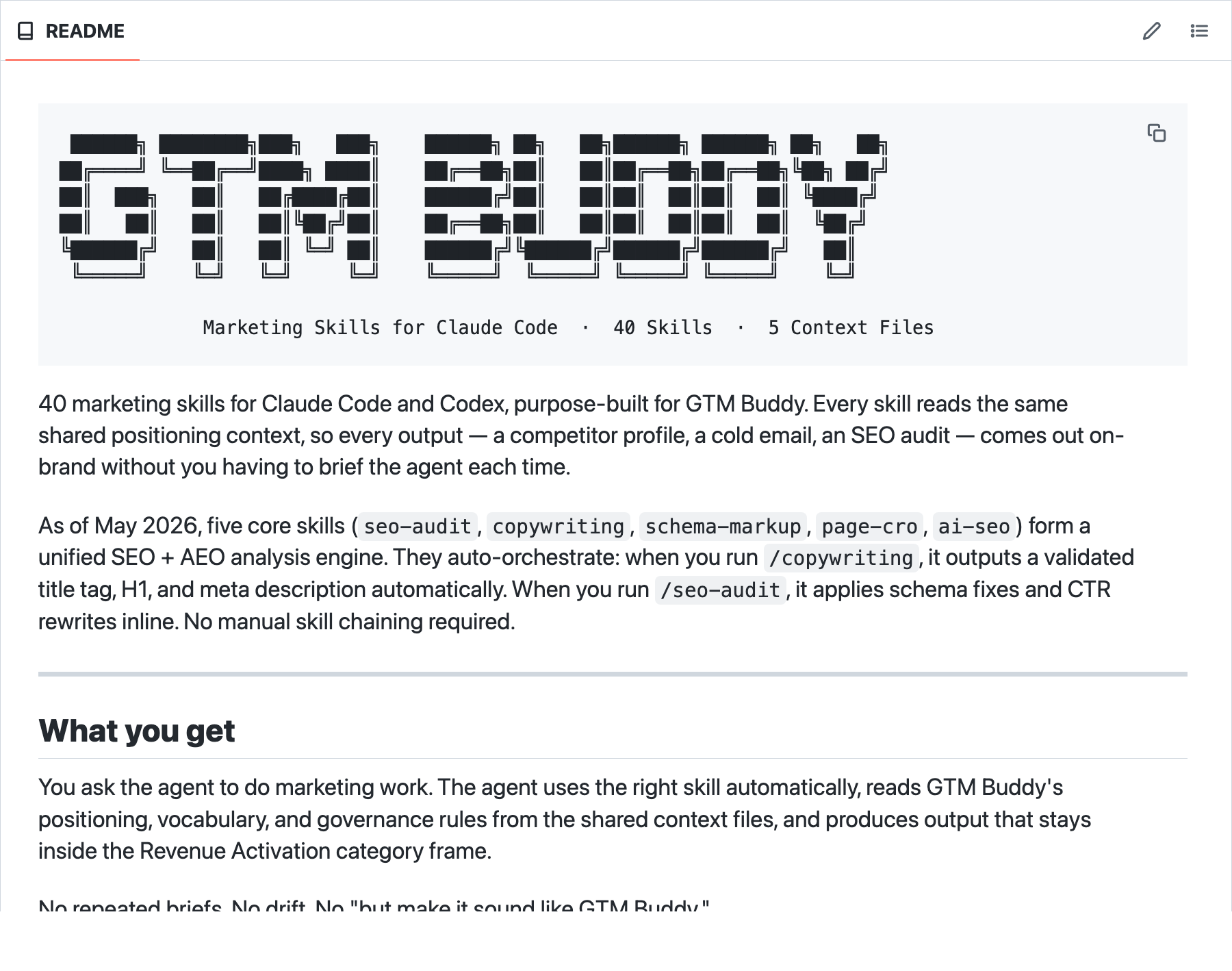
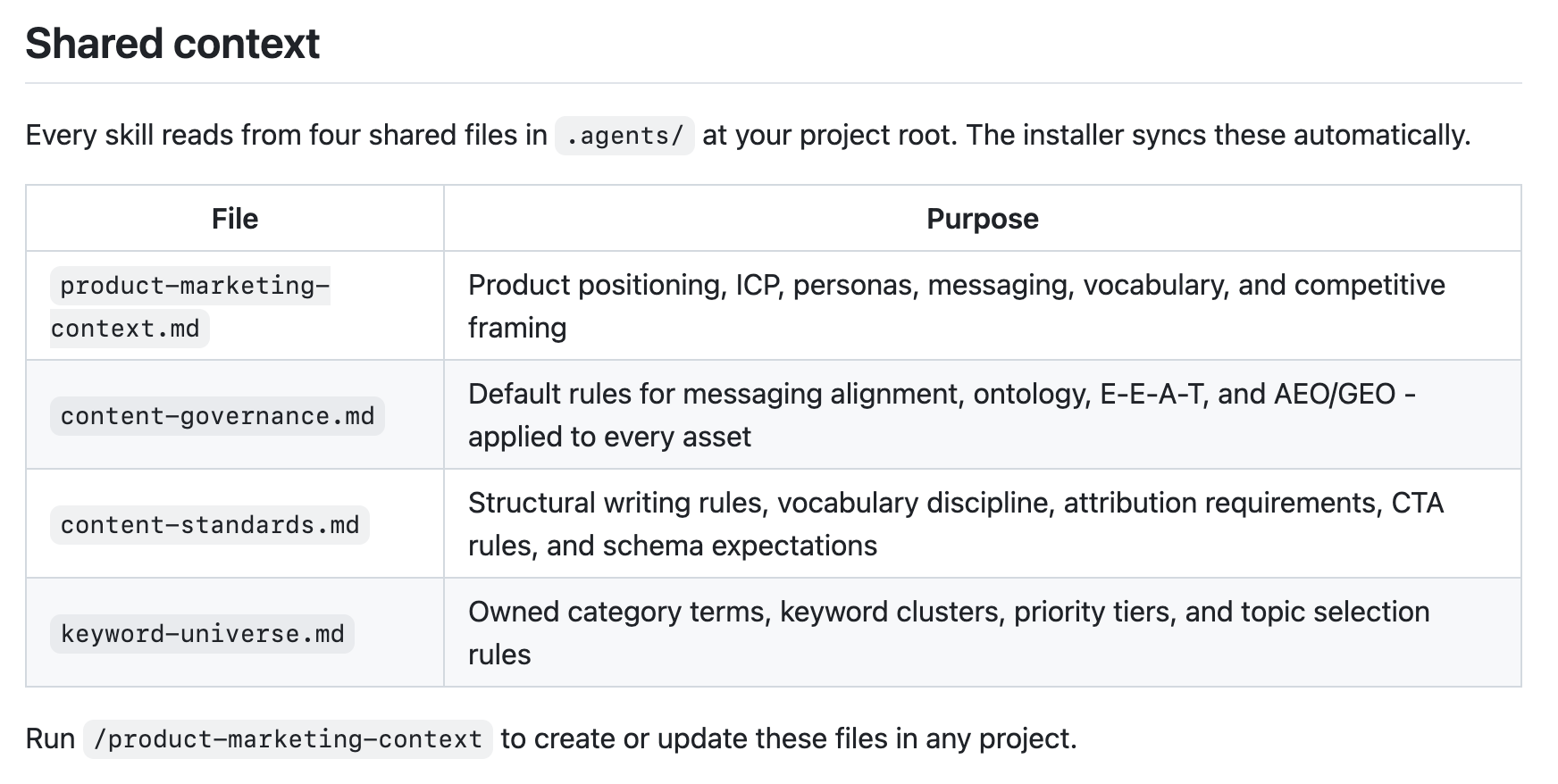
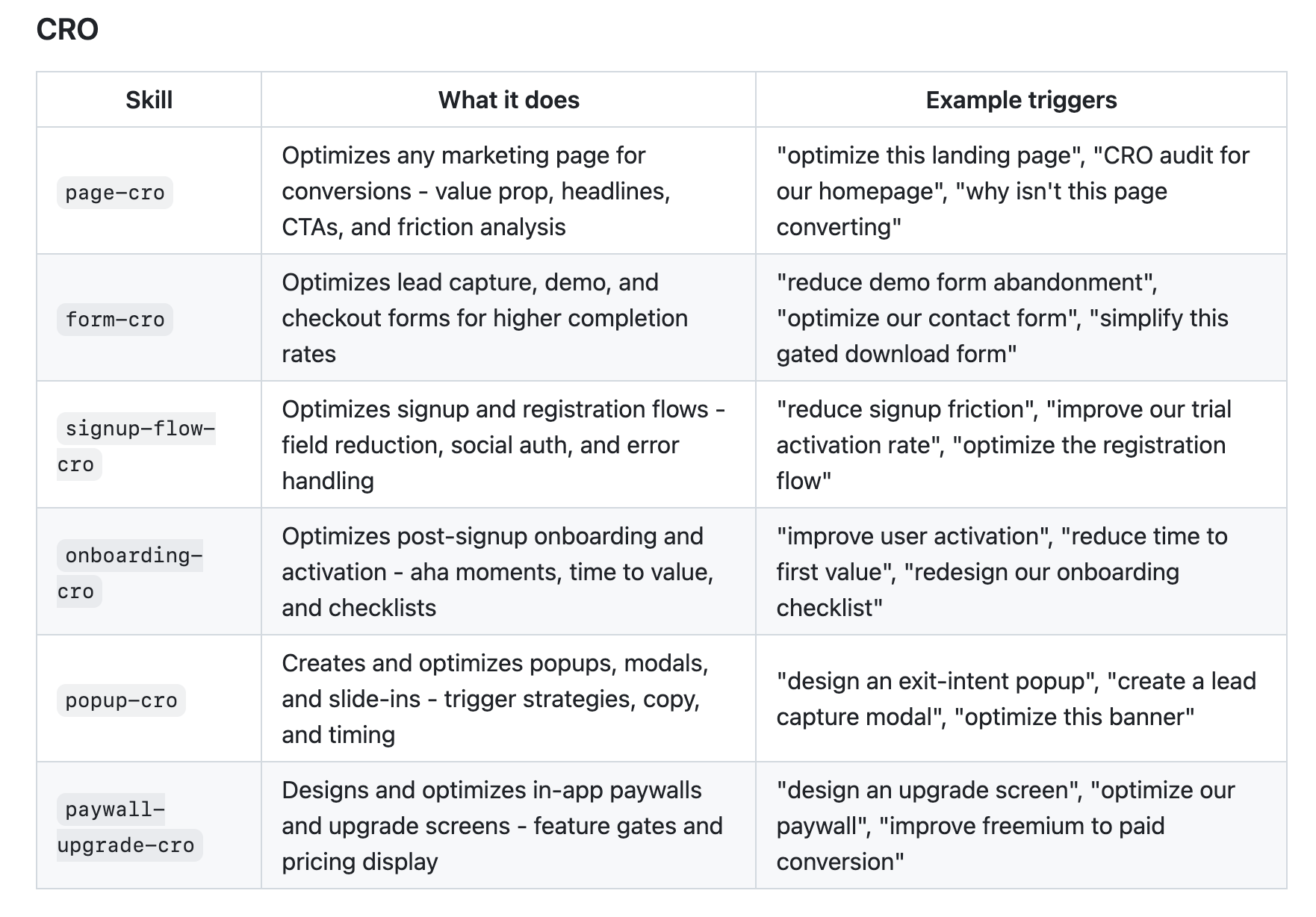
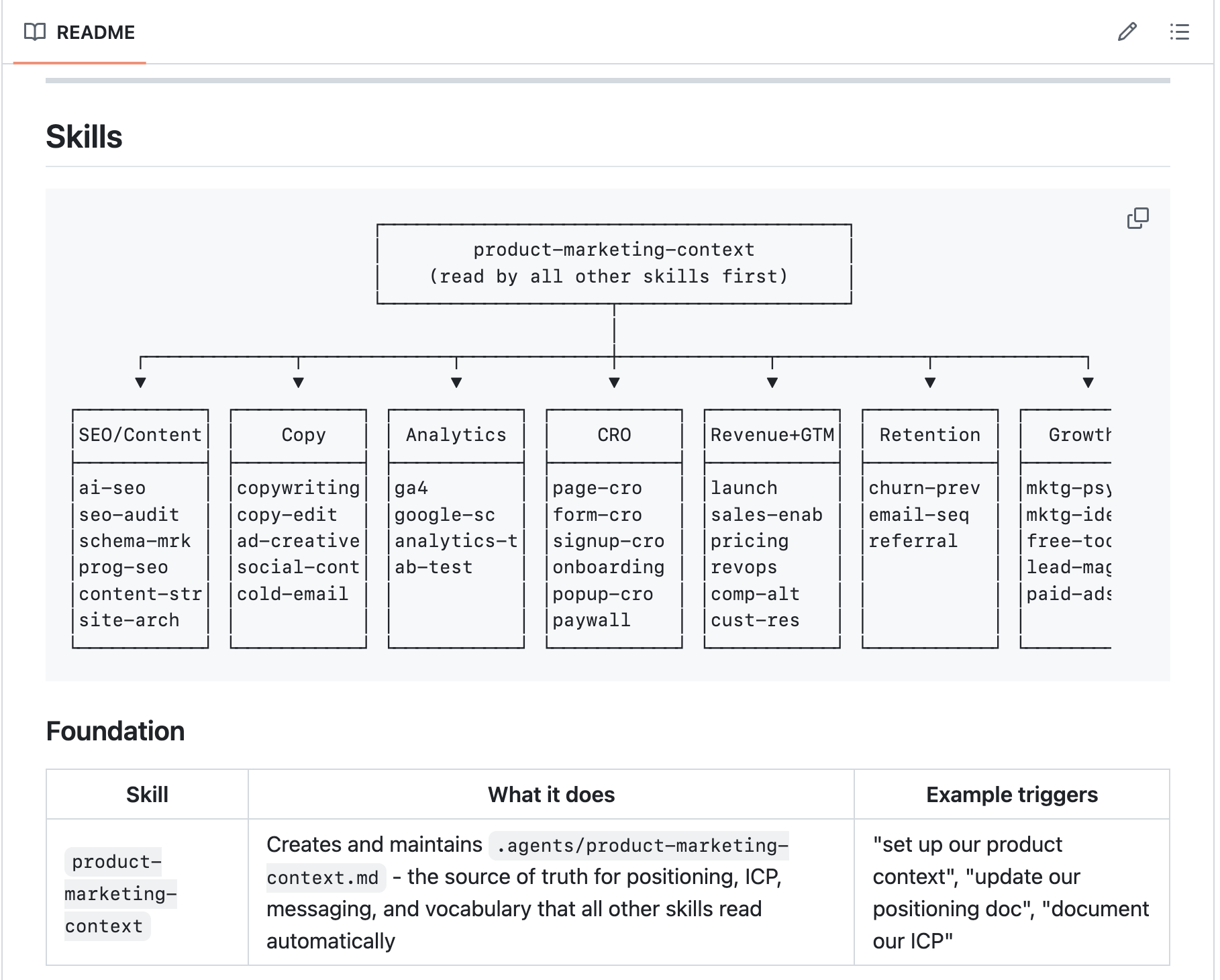
<p>The marketing team works out of GitHub. We forked skills from marketing-skills.com and skills.sh, reverse-engineered outputs from other teams, contextualized them to our organization’s needs and constraints, and built on top of them.</p>

<p>You don’t necessarily have to start from scratch every time.</p>

<p><img src="/assets/images/posts/skills-repository-readme.png" alt="GTM Buddy marketing skills repository README overview" width="1800" height="1418" loading="lazy" /></p>

<p><img src="/assets/images/posts/skills-taxonomy.png" alt="Skills taxonomy overview — how all skills relate to the shared product-marketing-context foundation" width="1744" height="878" loading="lazy" /></p>

<p><img src="/assets/images/posts/skills-shared-context.png" alt="Shared context files read by every skill automatically" width="1762" height="1228" loading="lazy" /></p>

<p><img src="/assets/images/posts/skills-cro.png" alt="CRO skills in the repository — page-cro, form-cro, signup-flow-cro, and more" width="1818" height="1460" loading="lazy" /></p>

<p>I constantly maintain this repository and ship skill and workflow updates every week. I also do a virtual lunch-and-learn with the team on how I’m using it, and how I would if I were in their seat.</p>

<p>Change management must be led from the front.</p>

<h3 id="workflows">Workflows</h3>

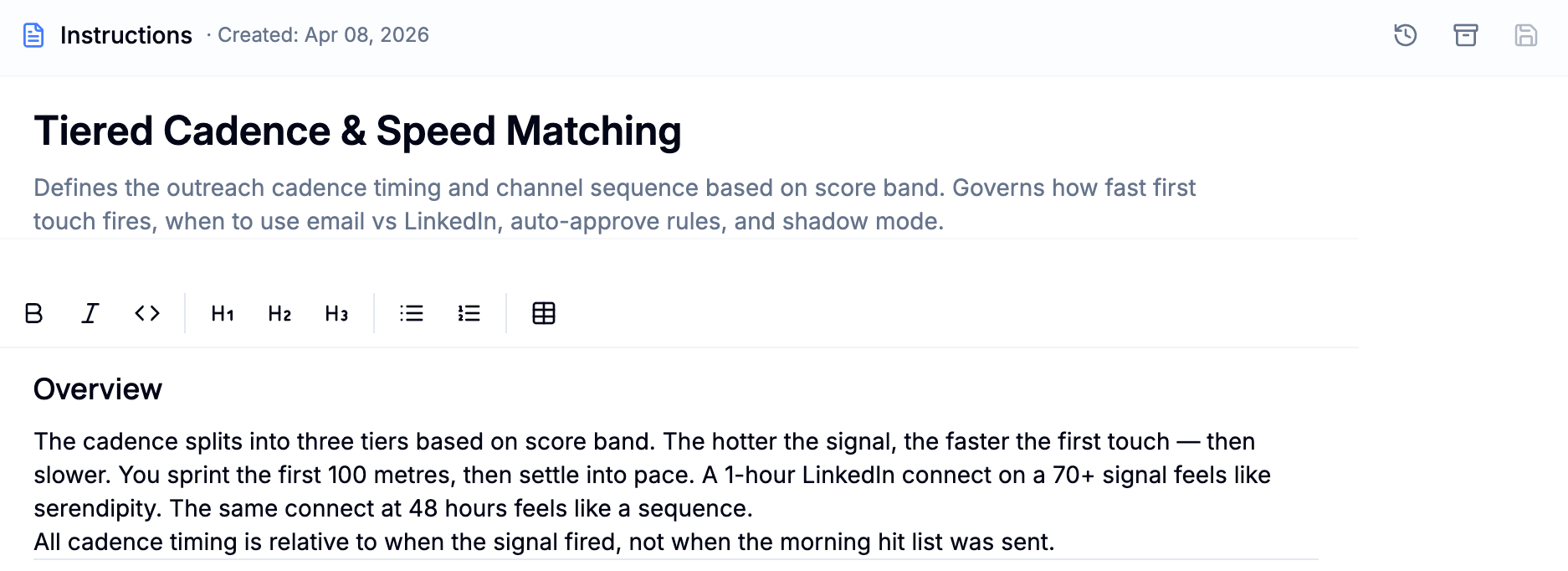
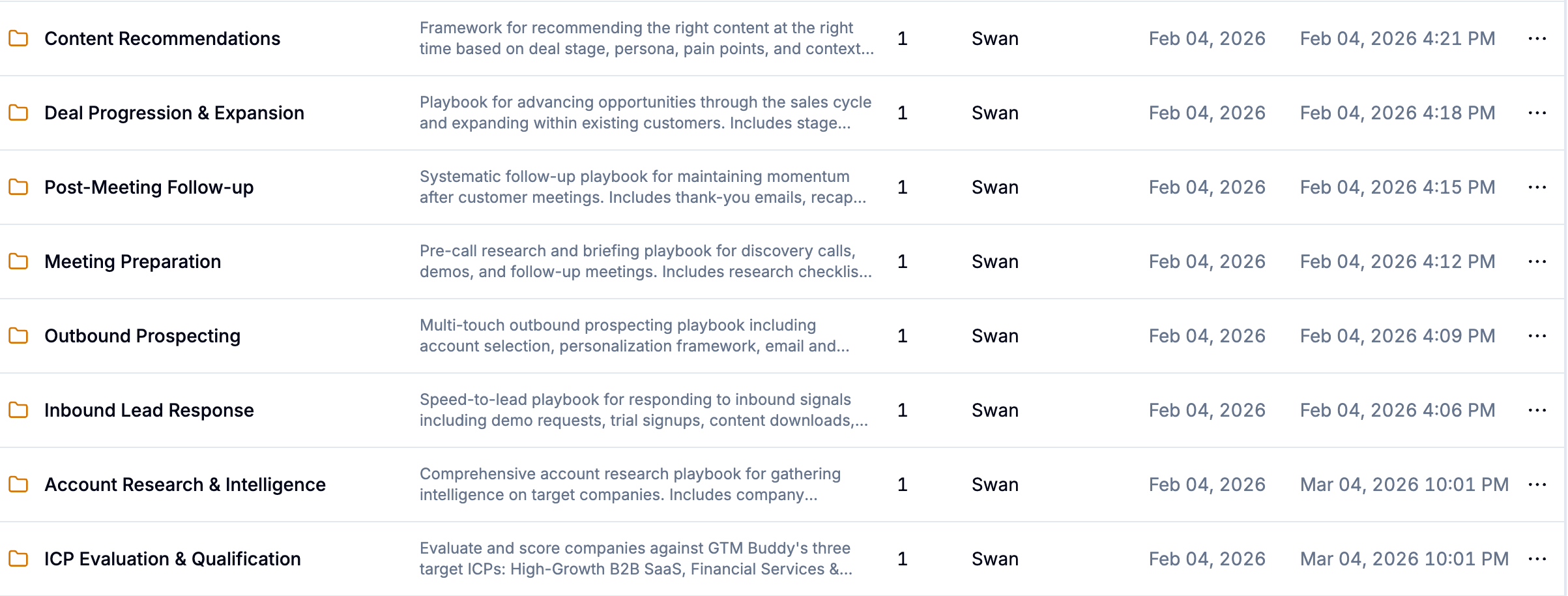
<p>We use SwanAI for automating GTM workflows from Slack — deanonymizing website visitors, crafting personalized hyper-contextual outreach messages (automating SDR work), account research, deal and pipeline reviews, sending data to CRM, and much more. We do a lot of “Vibe GTM” and prompt our way through ensuring GTM runs smooth.</p>

<p><img src="/assets/images/posts/swanai-cadence.png" alt="SwanAI — Tiered Cadence &amp; Speed Matching workflow" width="1874" height="682" loading="lazy" /></p>

<p><img src="/assets/images/posts/swanai-workflows.png" alt="SwanAI — GTM playbooks running from Slack" width="2406" height="914" loading="lazy" /></p>

<hr />

<h2 id="wrapping-it-up">Wrapping it up</h2>

<p>As an “agentic manager” — and this holds true for any manager, anywhere — my roles and responsibilities are to:</p>

<ol>
  <li><strong>Coach and elevate performance.</strong> The leading indicator for me is that ICs work on increasingly complex problem statements over time.</li>
  <li><strong>Work once, automate it next time.</strong> The team has a clear goal: never do the same work twice. The team is incentivized to automate their work at the end of every project. If you started a task at 0% last time, you have to start it at 40% the next time.</li>
  <li><strong>Only work on tasks closest to revenue impact.</strong> Say no a lot more. A key goal I’m constantly working on with the team is sharpening their judgment so they know what requests to pick up and what to push back on.</li>
  <li><strong>Average revenue per employee is the one metric that matters.</strong> Everything else follows. If my designer is working on redoing the website, they’re required to make design decisions reverse-engineered from what will move the revenue needle. Aesthetics and vibe need to be the consequence, not the driver.</li>
  <li><strong>Reframe the reward.</strong> The dopamine hit needs to shift from promotions and titles to how the market responds and whether you’re hitting your revenue goals.</li>
  <li><strong>Documentation is everything.</strong> Every month, I train my team on skills. For Q2, it’s stakeholder management and building a business case. The ask is to write a detailed, data-backed document and email it to me. I find ways to shoot it down. They push back with stronger arguments. We spar on email — this improves multiple skills, especially managing upward.</li>
</ol>]]></content><author><name>Varun Choraria</name><uri>https://www.varunchoraria.com/about/</uri></author><category term="management" /><category term="leadership" /><category term="career" /><category term="ai" /><summary type="html"><![CDATA[It's been about a quarter since I became a manager. Here's what I've figured out about what a manager's source of value actually is in the agentic world.]]></summary></entry><entry><title type="html">So you want to help your team succeed</title><link href="https://www.varunchoraria.com/so-you-want-to-help-your-team-succeed/" rel="alternate" type="text/html" title="So you want to help your team succeed" /><published>2026-02-07T00:00:00+05:30</published><updated>2026-02-07T00:00:00+05:30</updated><id>https://www.varunchoraria.com/so-you-want-to-help-your-team-succeed</id><content type="html" xml:base="https://www.varunchoraria.com/so-you-want-to-help-your-team-succeed/"><![CDATA[<p>It’s been about a month since I’ve been a first-time manager. Before I started, I asked my CEO what advice he had for me. Here’s what he said:</p>

<ol>
  <li>Partner, don’t command</li>
  <li>Don’t throw weight around because of the title. It’s alright if it happens unknowingly, but it’s crossing a line when done intentionally</li>
  <li>Take up more work, because that’s how you build trust</li>
</ol>

<p>I understood these, because it was simple and straightforward. Coming from an IC background, this was sort of natural to me anyway because I didn’t know how to lead. But then, there came a point very recently when I realized the entire marketing team was tiny, four folks including me.</p>

<!--more-->

<h2 id="the-problem-with-a-tiny-team">The problem with a tiny team</h2>

<p>That’s a natural setup both in the age of AI as well as in a company at the Series A stage, but I was in a tug-of-war between two very difficult problem statements:</p>

<ol>
  <li>Marketing traditionally was not seen as a growth lever. We had an ambitious charter of both category creation as well as driving pipeline. Driving pipeline is a straightforward mandate, but not when you have to revisit your basics of ICP and lead qualification. Over and above that, we were also trying to cope with AI and automations, trying to do our job once and then automate it using skills probably the next time.</li>
  <li>The second issue was about unlocking capacity of each team member. That meant better ownership, accountability, craftsmanship, and also becoming a strategic thinker. Being strategic at the outset for us meant one thing: what is our unique insight about both our swim lanes, as well as the market?</li>
</ol>

<p>When deadlines started becoming tighter and constraints more unforgiving, I was in a spot where I had to reach out to my manager, the CMO, to also wear an IC hat and step in. We needed all hands on deck because we were creating a whole new market category.</p>

<p>To my surprise, my manager said one thing: “Give me more work to do. Assign tasks like you would generally to your reports.”</p>

<p>This was unusual for me, since I always assumed you would only go to your higher-ups with solutions to problems, not work itself. Asks are different because they’re project and stakeholder dependencies. Here I was, coming up with a laundry list of items to work on.</p>

<h2 id="what-servant-leadership-means">What servant leadership means</h2>

<p>That’s when my manager introduced me to “servant leadership” as a concept. I loved it, and I’m in the process of internalizing it myself, but here’s what I’ve understood about it:</p>

<p>A true leader’s goal is to serve those they lead. It’s kind of like taking the inverse of a problem you have and reverse engineering it. Because if you think about it, a leader’s real mandate is to drive influence, not direct and execute.</p>

<p>And this makes logical sense to me, because if you think about it:</p>

<ol>
  <li>Maslow’s law dominates it all. If needs are met, belonging and growth in the context of career, meaningful contributions happen.</li>
  <li>As an ex-IC, and I hard relate, system and work constraints bubble up from the bottom.</li>
  <li>Motivation and incentives are tightly coupled. That’s when folks really go above and beyond, and I believe you need that in any setup.</li>
</ol>

<h2 id="putting-it-into-practice">Putting it into practice</h2>

<p>And I’m unsure if I’m right in doing this, and time will tell, but here’s how I’m putting thought to action:</p>

<ol>
  <li>Whenever a task needs to be done or assigned, I always lead with one question: “what do you think about this approach?” It might sound simple, but my notion with that is to make everything we do a partnership. Decisions need to be democratic. Information needs to flow transparently, and bi-directionally, regardless of good or bad.</li>
  <li>Building people first. I’m approaching this by guiding teammates to become more strategic. Take your task, automate it or make it into a dashboard, and then you’re responsible for sharing insights, correlations, and causations. All tied to core business metrics, not just what you handle.</li>
  <li>Removing barriers. This is a tricky one. Barriers are often cultural, that manifest as technical. I openly conveyed that marketing was not conventionally seen as a growth lever, and it must. So any task we pick up needs to be closest and directly in service of revenue. And so when random work comes through from other teams, we clarify the need of it based on revenue impact. If focused effort becomes culture, then process becomes ammunition and a force multiplier, not a defensive shield.</li>
  <li>Lastly, one thing another mentor of mine said is that being a leader is a very thankless job. You’re paid more to shield your team from shit, to bring clarity to the table, and genuinely invest in the growth of others. That means pointing the limelight to them. No one will ever thank you when BAU happens as intended, even though there’s a lot that goes into it.</li>
</ol>]]></content><author><name>Varun Choraria</name><uri>https://www.varunchoraria.com/about/</uri></author><category term="management" /><category term="leadership" /><summary type="html"><![CDATA[It's been about a month since I've been a first-time manager, and servant leadership is the idea I'm trying hardest to internalize.]]></summary></entry></feed>